
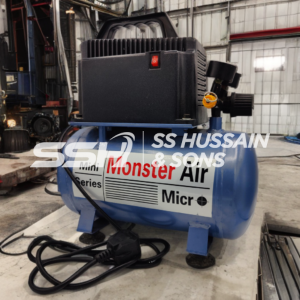
Air Compressing Unit Main (1)
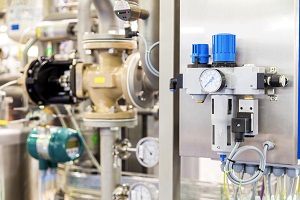
Air Preparation Unit (8)
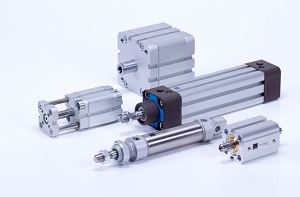
Pneumatic Cylinders (22)
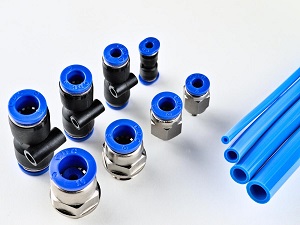
Pneumatic Fittings & Tubes (29)
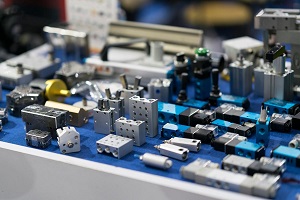
Pneumatic Valves (33)
Pneumatic Equipment in Pakistan — Cylinders, Valves, Fittings & Air Preparation
If instrumentation is the nervous system of a plant — telling you what’s happening — pneumatics is the muscle. It’s what actually pushes, lifts, clamps, and moves. And like muscle, it only works as well as the supply feeding it: a cylinder is only as reliable as the air quality reaching it, the valve switching it, and the fittings holding the whole circuit together without a leak.
We supply the full pneumatic chain to manufacturers, packaging lines, and automation integrators across Pakistan — air compressing units, air preparation (FRL) units, directional and mechanical valves, cylinders in every standard configuration, and the fittings and tubing that connect them. Genuine SMC, Festo, and Airtac stock, backed by 25+ years of installing and repairing this exact equipment in Karachi’s industrial belt and beyond.
The Anatomy of a Pneumatic System
Every pneumatic circuit follows the same basic path, and knowing it makes component selection far less confusing:
- Air Compressing Unit — generates the compressed air supply that powers everything downstream.
- Air Preparation Unit (FRL) — filters, regulates, and (where needed) lubricates that air before it reaches sensitive components.
- Pneumatic Valves — direct the flow of that prepared air to the right actuator, at the right moment.
- Pneumatic Cylinders — convert the air pressure into the actual push, pull, lift, or clamp motion.
- Fittings & Tubes — the connective tissue linking every stage, and usually the first place a system starts leaking.
Weakness anywhere in that chain shows up as a symptom somewhere else — a cylinder that seems underpowered is often just starved of clean, regulated air, not actually undersized. We stock and advise on every stage, not just the part that happens to be failing.
Air Preparation Units (FRL)
An FRL — filter, regulator, lubricator — is cheap insurance against the two things that kill pneumatic components early: dirty air and inconsistent pressure. The filter strips out moisture and particulate before it reaches a valve or cylinder seal; the regulator holds pressure steady regardless of what else is drawing air off the same compressor line; the lubricator (where fitted) keeps moving parts from running dry. We supply these as standalone units — filters, regulators, lubricators individually — or as combined FR and FRL assemblies sized to your line.
Pneumatic Valves
The valve is the decision-maker of the circuit — it determines when and where compressed air actually goes. Choosing the wrong type is the single most common cause of a pneumatic system that “works but not reliably.”
| Valve Type | How It’s Actuated | Typical Use |
| Directional Control Valve | Solenoid (electrical), pilot air, or manual | Routing air to extend/retract a cylinder or actuator |
| Fluid Control Valve | Manual or automated flow adjustment | Regulating flow rate/speed of actuator movement |
| Mechanical Valve | Roller, lever, or plunger contact | Position-triggered switching without electronics |
| Solenoid Valve Manifold (Base Plate) | Multiple solenoids on a shared base | Controlling several actuators from one compact station |
Pneumatic Cylinders
A cylinder is mechanically simple — a barrel, a piston, a rod, and seals — but the configuration options are where projects go right or wrong. We stock four main families, each solving a different space or motion problem.
| Cylinder Type | Standard/Series | Best Suited For | Key Trait |
| Round Cylinders | ISO 15552 / ISO 6432 | General automation, standard machine builds | Widest range of bore and stroke options |
| Compact Cylinders | Short-body design | Tight spaces, machine panels, packaging equipment | Same force output, much smaller footprint |
| Guided Cylinders | Twin-rod / anti-rotation design | Pick-and-place, alignment-critical motion | Resists load rotation and side loading |
| Grippers | Parallel or angular jaw | Robotic handling, part transfer | Precise clamping force in a compact unit |
Five Numbers to Confirm Before You Order a Cylinder
- Bore diameter — sets the force output at a given air pressure; undersized bores are the most common sizing mistake we see.
- Stroke length — the actual distance the piston needs to travel; measure the full motion, not just the working distance.
- Line pressure (bar) — force calculations are meaningless without knowing your actual supply pressure, not the compressor’s rated maximum.
- Mounting configuration — foot, flange, trunnion, or clevis — dictated by the machine frame, not the cylinder catalogue.
- Cushioning and sensing needs — adjustable end cushions prevent impact damage at speed; magnetic piston sensing enables position feedback if your control system needs it.
Pneumatic Fittings & Tubes
The least glamorous part of any pneumatic system and, in our service calls, the most common source of an air leak nobody can locate. Push-in fittings dominate modern installations for the simple reason that they’re fast to assemble and easy to inspect — we stock straight, elbow, tee, and bulkhead configurations alongside polyurethane tubing in the standard metric sizes used across Pakistani machine builds.
Keeping a Pneumatic System Running (Not Just Installed)
- Check rod seals for leaks regularly — a hissing sound at the seal is the earliest warning sign, well before performance visibly drops.
- Inspect the piston rod for scoring or corrosion — a damaged rod surface will cut a new seal almost immediately after replacement.
- Keep the FRL unit maintained, not just installed — a clogged filter or drifted regulator quietly degrades every component downstream of it.
- Re-torque mounting bolts on a schedule — vibration loosens cylinder and valve mounts long before anyone notices misalignment.
- Adjust cushioning if you hear end-of-stroke impact — that knock is the cylinder telling you it’s about to fail early.
When a cylinder does wear out, replacement isn’t always the only option — we run a dedicated pneumatic cylinder repair service that rebuilds seals, rods, and end caps at a fraction of new-unit cost.
Why Pakistani Manufacturers Buy from SS Hussain & Sons
- System-level advice, not just parts. We size the whole chain — compressor, FRL, valve, cylinder — so the failure point isn’t just moved somewhere else.
- Repair, not just replace. Our dedicated cylinder repair service extends the life of equipment you’ve already paid for.
- Genuine SMC, Festo & Airtac stock. With manufacturer documentation, not unverifiable grey-market units.
- 25+ years across Pakistani industry. From textile mills in Faisalabad to pharma lines in Karachi — we know how this equipment actually performs under local conditions.
- Nationwide delivery from Karachi. Serving Lahore, Islamabad, Faisalabad, Multan, Sialkot and beyond.
Frequently Asked Questions
How does a pneumatic cylinder actually work?
Compressed air enters the cylinder barrel and pushes against the piston, driving the piston rod outward (or, in a double-acting cylinder, in both directions as air alternates sides). That linear motion is then used to push, pull, lift, or clamp whatever the machine is built to do.
Should I choose a single-acting or double-acting cylinder?
Double-acting cylinders use air pressure to move in both directions and are the standard choice for most industrial automation because they offer more controlled, repeatable motion. Single-acting cylinders, which use a spring to return, are typically reserved for simpler tasks or fail-safe applications where the rod must retract automatically if air supply is lost.
What does FRL mean, and do I actually need one?
FRL stands for Filter, Regulator, Lubricator — the unit that conditions compressed air before it reaches your valves and cylinders. Almost every industrial pneumatic system benefits from at least a filter and regulator; lubrication is only needed for components specifically designed to run on lubricated air.
Why does my pneumatic cylinder keep losing air pressure?
The most common cause is a worn rod seal, often accelerated by a scored or corroded piston rod, dirty supply air, or a machine that’s simply run past its seal’s service life. Loose fittings and cracked tubing are the second most common culprit, and are usually cheaper and faster to fix.
What’s the difference between a directional control valve and a mechanical valve?
A directional control valve routes air electrically (via solenoid) or pneumatically to control an actuator remotely — the standard choice for automated machines. A mechanical valve is triggered by physical contact, such as a roller or lever, and is used where a simple, electronics-free position trigger is enough.
