
-
Address: Shahrah-e-Liaquat,
Serai Quarters 74000, Karachi -
Call Us: +92 319 3961178
Email Us: info@sshussain.com
Quick Answer
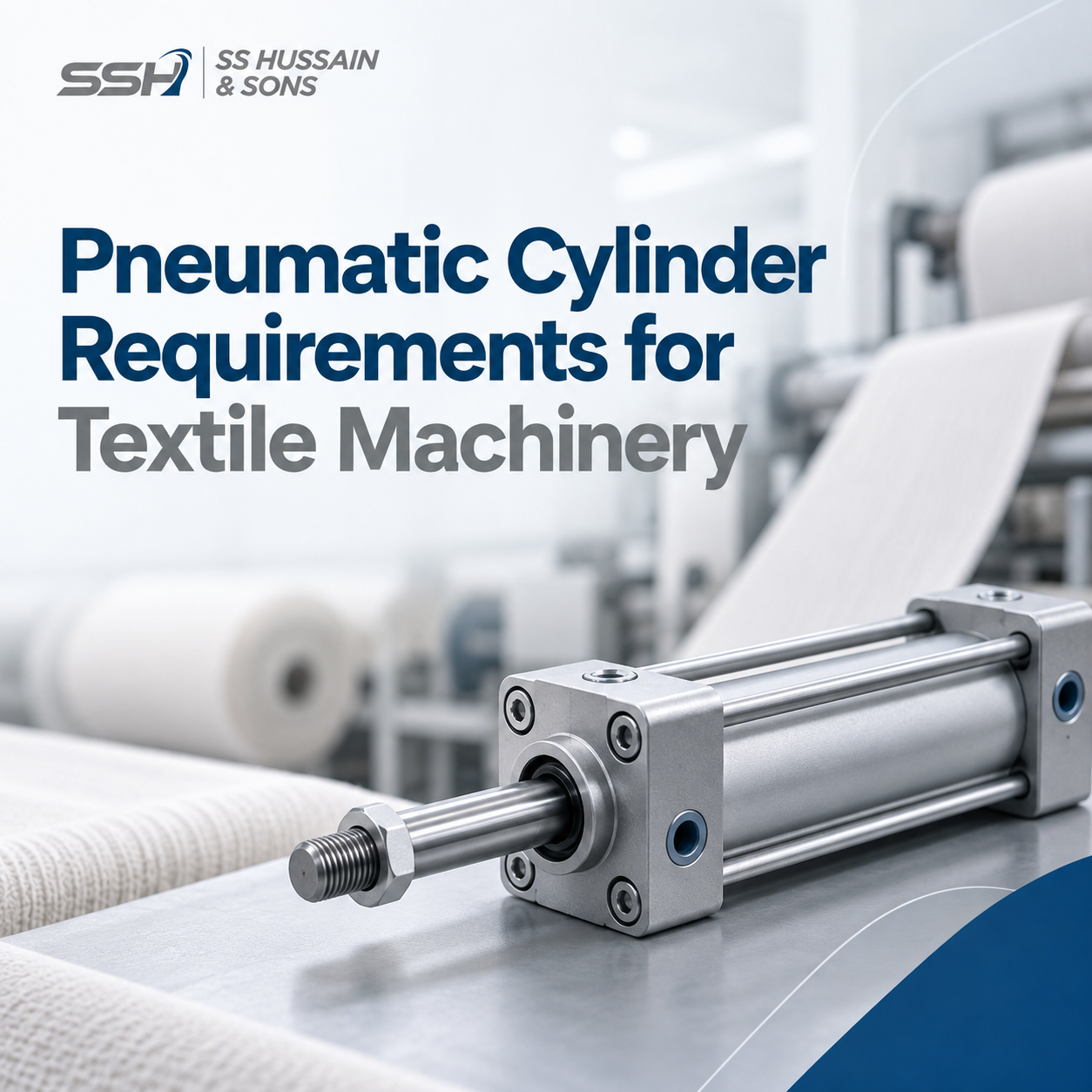
For textile machinery, a pneumatic cylinder needs to have the right bore size and stroke, as well as protection from lint, dust, humidity, and heat. Lint is the main cause of early cylinder failures in textile mills, and if you choose the right seal material and rod type for your mill’s working conditions, the cylinder will last a lot longer.
Where Textile Machines Use Pneumatic Cylinders
- Spinning: controls yarn tension and helps load drafting rollers
- Weaving: drives loom shedding, picking, cutting, and edge control
- Dyeing and finishing: opens and closes valves to control dye and chemical flow
- Inspection and packing: clamps, flips, and moves fabric along conveyors
4 Things to Check Before You Order
- The amount of force your cylinder can produce is based on its bore size. Since force = pressure x piston area, it’s best to size the bore for about 1.5 to 2 times the force your load actually needs. This will allow for friction, acceleration, and wear. For vertical lifts, you might need an even bigger safety margin.
- Stroke length is how far the cylinder has to move . Figure out how far the part has to move , then add a little to allow for adjustment . If you select a stroke longer than you need , you will simply be adding cost , not a meaningful benefit.
- The way the cylinder is mounted affects how well it handles side loads. Foot or flange mounts work best for movement in a straight line, while clevis or trunnion mounts work best when the load moves in an arc. Using the wrong mounting style can damage a cylinder that is the right size otherwise.
- Cushioning helps avoid damage to the end cap. This is particularly critical because looms and spinning frames can cycle thousands of times a day. Without sufficient cushioning, the piston bangs into the end cap over and over, eventually loosening mounting nuts and causing premature wear.
Why Lint Can Be A Problem
More cylinder failures in textile mills result from lint and fiber dust than from any other reason . Fine dust forms on the piston rod and is dragged into the seal with each stroke , thereby wearing the seal down and allowing air to seep by . The interior of the cylinder tube can also be scratched.
What to specify:
- A cylinder with a rod wiper seal designed for fine particles rather than general dust protection
- A dust-protected or fully sealed rod where the application allows it
- A regular cleaning schedule around carding, spinning, and weaving stations, where lint levels are usually highest
Humidity and Heat
Under humidity, standard steel rods rust quickly, especially in dyeing and wet-processing areas where the cylinders are continually exposed to moisture. Stainless steel rods are the preferred choice in these environments.
Heat also affects standard seals, with standard NBR seals being used in the range of about -5°C to 70°C. However, temperature around heat-setting machines and drying units can be much higher and can cause cracking and hardening of NBR seals which is why FKM (Viton) seals are a better choice in high-heat applications
Why Do You Need an FRL Unit?
An FRL unit (Filter-Regulator-Lubricator) is one of the most affordable ways to extend pneumatic cylinder life by filtering, regulating, and lubricating the compressed air before it reaches the cylinder, helping to prevent inside contamination and wear, since dirty air can cause many of the same problems as external lint.
Buying Checklist
- Load and force, with a safety margin
- Bore size matched to the required force
- Stroke length matched to the required travel distance
- Mounting style matched to the motion path
- Cushioning matched to the cycle speed
- Seal material matched to heat exposure
- Rod material matched to humidity exposure
How SS Hussain & Sons Can Help
We supply pneumatic cylinders and air preparation equipment for textile machinery across Pakistan, including Festo, SMC, Airtac, and HTC, while our team can also help you select the right seal, rod, and FRL setup based on your mill’s operating conditions, so you can avoid unnecessary wear and get longer service life from your pneumatic system, Get a Quote
FAQs
What causes pneumatic cylinders to fail early in textile mills?
Lint and fiber dust are the main causes, as they wear down rod seals and can scratch cylinder tube, eventually leading to air leaks and reduced force
What seal should I use near heat-setting machines?
FKM (Viton) is the better choice because standard NBR seals can crack when temperatures rise above about 70°C
Do I need stainless steel rods in a dyeing area?
Yes, especially when the area stays consistently humid, because standard steel rods can begin to rust within months
What does an FRL unit do?
It filters, regulates, and lubricates compressed air before it reaches the cylinder, helping protect it from internal contamination and unnecessary wear