
-
Address: Shahrah-e-Liaquat,
Serai Quarters 74000, Karachi -
Call Us: +92 319 3961178
Email Us: info@sshussain.com
Quick Answer
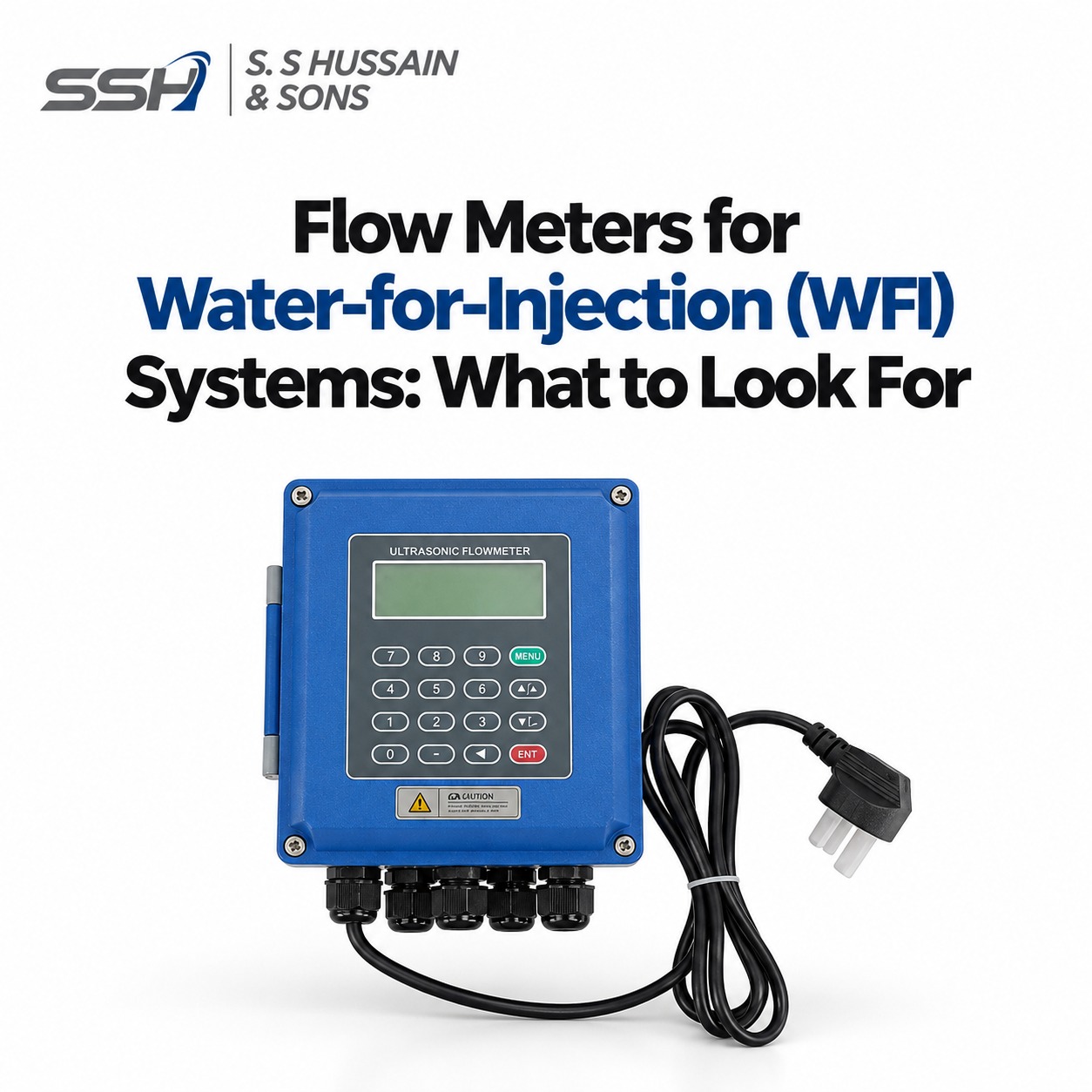
A flow meter for a Water-for-Injection (WFI) system must work on very low-conductivity water and survive continuous, hot loop circulation. The best option never touches the fluid at all. Clamp-on ultrasonic meters meet all three requirements. Oval gear meters, diesel-style meters, and standard vortex meters do not, and should be avoided.
Why Standard Electromagnetic Flow Meters Don’t Work on WFI
Electromagnetic flow meters cannot read WFI accurately because WFI has very low electrical conductivity.
These meters need the fluid to conduct electricity to take a reading. WFI does not carry enough electrical charge for that to work reliably. This one fact rules out one of the most commonly used flow meter types in general industry, right from the start.
Why a Non-Contact Meter Is the Better Choice for WFI
A flow meter that never touches the water avoids the hygiene problem entirely. Clamp-on ultrasonic meters sit on the outside of the pipe.
Because these meters don’t touch the fluid, there are no wetted parts to worry about, no hygienic fittings to source, and no sanitary certification needed on the sensor itself. The meter measures flow by sending sound waves through the pipe wall and the water inside.
Wall-Mounted vs Portable Ultrasonic Meters: Which One You Need
Pick the ultrasonic type based on how you monitor your WFI loop, since GMP requires continuous tracking, not occasional checks.
- Wall-mounted (stationary) ultrasonic: Built for continuous WFI loop monitoring. This is what GMP’s ongoing-tracking requirement actually calls for.
- Portable or handheld ultrasonic: Built for spot-checks, troubleshooting, or periodic verification. Not meant to serve as your main, continuous monitor.
Other valid but less common options exist too, including Coriolis mass flow meters, SAW (surface acoustic wave) meters, and sanitary turbine meters.
Flow Meter Types to Avoid for WFI Systems
Three common flow meter types do not belong in a WFI line, and using them is a mistake regardless of price or availability.
- Oval gear meters: Built for diesel, oil, and other viscous fluids. Not designed for water.
- Diesel-style meters: Built for fuel measurement. Wrong application entirely.
- Standard vortex meters: Built for general industrial use. Not designed to meet hygienic water requirements.
What to Confirm Before You Buy a WFI Flow Meter
Ask your supplier for calibration documentation with clear traceability before you commit to a purchase. You’ll need this for your GMP audit trail, regardless of which meter type you choose.
This is a separate check from picking the right meter type. Even the correct meter type is not useful without the paperwork to prove it performs as intended.
Bottom Line
A WFI flow meter must handle low-conductivity water, survive constant hot loop circulation, and ideally never touch the fluid. Clamp-on ultrasonic meters meet all three requirements. Use a wall-mounted unit for continuous monitoring, or a portable unit for spot-checks. Avoid oval gear, diesel-style, and standard vortex meters, since none of them are built for this application. Before you buy, confirm your supplier can provide proper calibration documentation for your records.
How SS Hussain & Sons Can Help
We supply wall-mounted, portable, and handheld ultrasonic flow meters that measure WFI without contacting the fluid. Our team can help you choose the right setup for continuous or spot-check monitoring, and support your calibration documentation needs. Get a Quote
FAQs
Why can’t I use a regular flow meter for WFI water?
Standard electromagnetic meters need the fluid to conduct electricity. WFI has very low conductivity, so these meters can’t read it accurately.
Does a clamp-on ultrasonic meter need to touch the water?
No. It sits on the outside of the pipe and measures using sound waves. This removes the need for hygienic wetted parts.
Should I use a wall-mounted or portable ultrasonic meter for my WFI loop?
Use a wall-mounted meter for continuous monitoring, which GMP requires. Use a portable or handheld meter for spot-checks and troubleshooting.
Can an oval gear flow meter be used for pharmaceutical water?
No. Oval gear meters are built for diesel, oil, and viscous fluids. They are not suitable for WFI or other pharmaceutical water systems.
What documentation should I ask for when buying a WFI flow meter?
Ask for calibration documentation with clear traceability. You will need this to support your GMP audit trail.