
-
Address: Shahrah-e-Liaquat,
Serai Quarters 74000, Karachi -
Call Us: +92 319 3961178
Email Us: info@sshussain.com
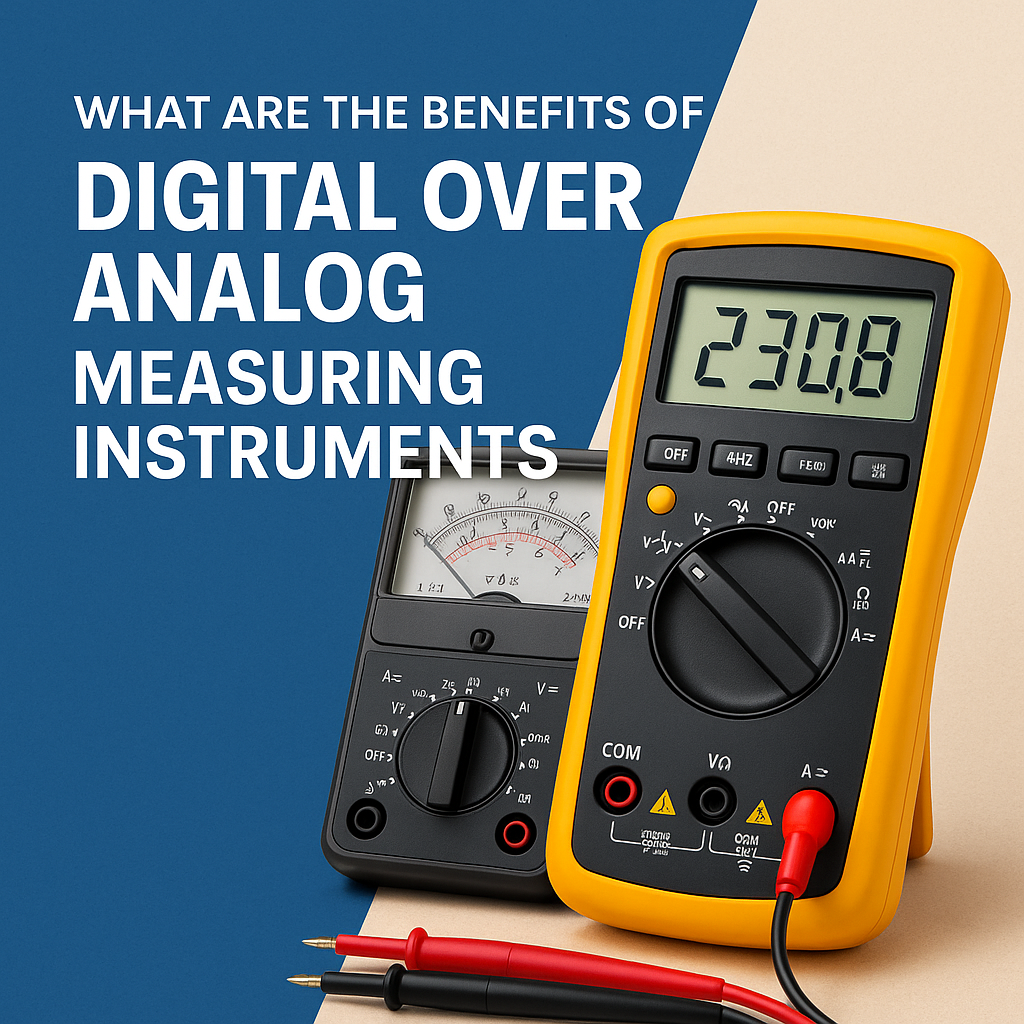
In today’s industries, from electrical testing to manufacturing, one thing is clear: digital measuring instruments have taken the lead over analog tools.
This change happened gradually as professionals started realizing how much accuracy, reliability, and speed matter in every measurement.
But what truly makes digital measuring instruments better? Why are analog meters slowly being replaced? And what do you need to understand before choosing one for your work?
Here’s a complete, practical breakdown that answers every question in one place.
How Measuring Instruments Actually Work
Every measuring instrument has one job: to detect and display a physical value such as voltage, current, pressure, or temperature.
Analog instruments do this through a pointer that moves over a scale. Your reading depends on how you see that needle and the angle at which you look.
Digital measuring instruments, on the other hand, use electronic circuits to convert that same physical signal into a precise number shown on a screen.
This single shift in design changes everything about how we measure, record, and analyze results.
Accuracy and the Human Eye Problem
Analog tools rely heavily on visual judgment. A small change in the viewing angle can lead to parallax error, where the pointer seems to show a slightly different value depending on where you stand.
Digital meters solve that instantly. They display exact numbers, such as 230.8 V instead of something between 230 and 240.
In electrical systems, laboratory work, and factory testing, those decimals matter. A 0.5% difference can determine if a circuit functions properly or fails under load.
High-end digital instruments often come with auto-calibration features that maintain stability over time. They can even detect minor drifts automatically, which means you don’t have to recalibrate manually as often as analog meters.
How Digital Precision Saves Real Results
When your readings are consistent and repeatable, you can track progress, find errors faster, and make changes confidently.
In industries like power generation, a small voltage misread can waste thousands of watts daily.
In pharmaceutical plants, inaccurate temperature control can spoil entire batches of medicine.
Digital measuring instruments help prevent these losses by removing guesswork from the equation.
Speed of Measurement and Safer Testing
Analog needles need a moment to settle before giving a stable reading. During that short time, you might misread or over-adjust something.
Digital meters display values almost instantly, often within milliseconds.
That speed makes a big difference when you’re testing live electrical circuits or fast-changing signals.
Some instruments even freeze the latest reading automatically, so you can look away from the meter without missing the value. This is especially helpful for technicians who need both hands free while testing.
Fewer Moving Parts, Longer Life
Analog instruments depend on moving parts like coils, springs, and pointers. Over time, these wear down, causing drift or inaccuracy.
Vibration, heat, and humidity also affect their performance.
Digital instruments use solid-state electronics with almost no mechanical components. This means they are more resistant to shock, last longer, and need less recalibration.
In heavy industrial or outdoor environments, this reliability saves a lot of time and cost.
One Device That Does It All
Most modern digital measuring instruments are multifunctional.
A digital multimeter, for example, can measure voltage, current, resistance, frequency, and sometimes temperature in one compact device.
Instead of carrying multiple analog meters, professionals now use a single tool that performs all measurements faster and more accurately.
This versatility makes digital devices ideal for electricians, field engineers, and maintenance staff who work in different environments.
Built-In Safety and Error Protection
Modern digital measuring instruments often include built-in protection systems.
If the test leads are connected incorrectly or if the input limit is exceeded, the meter shows a warning or shuts down automatically.
This helps prevent damage to both the instrument and the operator. Analog tools offer no such protection, so small connection mistakes can cause permanent faults.
By minimizing user error and protecting internal circuits, digital meters make daily work safer and more reliable.
Why Some People Still Use Analog Tools
Analog instruments haven’t disappeared completely.
They’re still used when technicians need to watch how a value changes smoothly over time rather than reading exact numbers.
For example, when testing how a current rises gradually, a moving needle helps visualize the trend.
Some modern digital meters now include bar graph displays to replicate that analog feel while still keeping numerical accuracy.
This hybrid design combines the familiarity of analog with the performance of digital.
Long-Term Value and Cost Efficiency
While digital meters can cost slightly more at the start, their long-term savings are significant.
They last longer, need less maintenance, and stay accurate for years.
You also save money by avoiding costly mistakes caused by human reading errors.
In most industries, downtime and incorrect readings cost far more than the price of a meter itself.
That’s why switching to digital measuring instruments is not just a technical upgrade but a financial improvement too.
Tips to Get the Most from Your Instruments
Here are some small but valuable insights that most people overlook:
- Let your digital meter run for a few minutes before using it. This allows the internal circuits to stabilize and give more accurate results.
- Avoid using meters near strong magnetic or static fields. They can slightly interfere with readings.
- Replace test leads regularly. Damaged or oxidized leads can cause up to 3% error even in high-end devices.
- Store your instruments in a dry, temperature-stable place. Moisture and rapid temperature swings can shorten their lifespan.
- If your meter allows, back up calibration data every few months. It helps you identify slow drift before it becomes noticeable.
Following these small steps improves accuracy and extends the tool’s life significantly.
Final Thoughts
Digital measuring instruments have become the standard for accuracy, reliability, and data-driven work.
They save time, reduce human error, and last longer in tough environments. Whether you work in electrical systems, industrial automation, or research labs, digital tools offer better control and confidence in every reading.
If you want accurate, durable, and advanced measuring instruments, visit SS Hussain.
SS Hussain provides a wide range of digital measuring tools trusted by professionals in Pakistan and beyond.
Upgrade your toolkit today and measure every detail with precision that delivers results