
-
Address: Shahrah-e-Liaquat,
Serai Quarters 74000, Karachi -
Call Us: +92 319 3961178
Email Us: info@sshussain.com
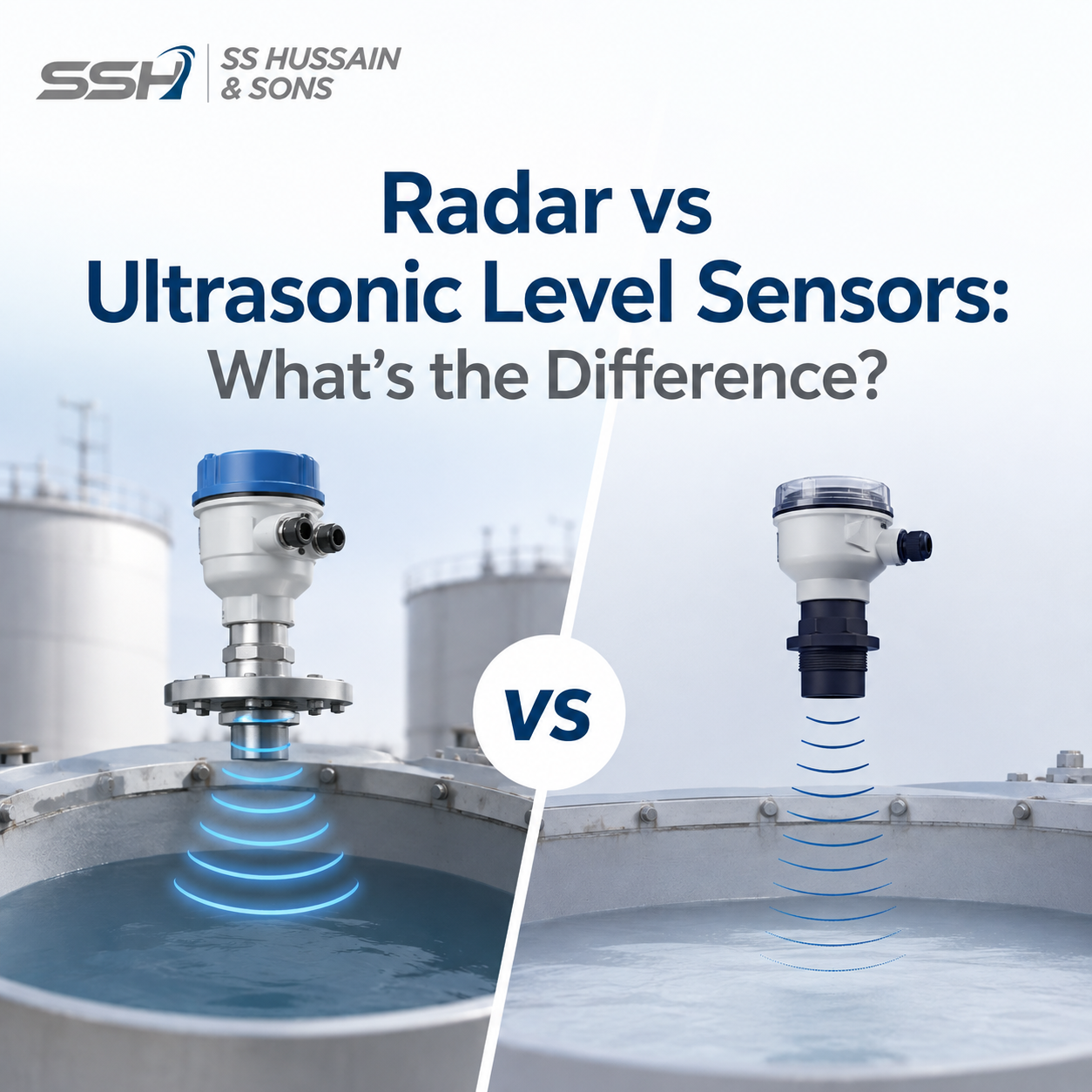
Picking a level sensor sounds simple until you realize two sensors that look almost identical can give completely different results in the same tank. One keeps delivering accurate readings day after day, while the other starts showing numbers that don’t quite make sense. The reason usually isn’t the sensor itself. It’s choosing the wrong technology for the job.
If you’re comparing radar vs ultrasonic level sensors, this guide will make the choice much easier. You’ll learn how each sensor works, where it performs best, what mistakes to avoid, and how to pick the right one without wasting money.
What Is the Difference Between Radar and Ultrasonic Level Sensors?
The biggest difference between a radar level sensor and an ultrasonic level sensor is the signal they use to measure level.
A radar sensor sends microwave signals toward the surface of the material. The signals bounce back, and the sensor calculates the distance from the return time.
An ultrasonic sensor follows the same idea, except it uses high-frequency sound waves.
That single difference changes how each sensor performs inside a tank. Steam, dust, foam, temperature changes, and even the layout of the tank can affect one sensor much more than the other.
Quick Comparison
| Feature | Radar Level Sensor | Ultrasonic Level Sensor |
| Signal used | Microwave | Sound wave |
| Best for | Steam, dust, vapors, foam, tall tanks | Clean liquids and stable conditions |
| Measuring range | Long | Medium |
| Accuracy | Very high | High in suitable conditions |
| Maintenance | Usually lower | May need more cleaning |
| Cost | Higher | Lower |
How Does a Radar Level Sensor Work?
A radar level sensor measures distance using microwave signals. The signal travels from the sensor to the surface of the liquid or solid, then returns to the sensor after bouncing back.
The sensor knows how fast the signal travels, so it can calculate the distance almost instantly. This process repeats continuously, giving accurate continuous level measurement throughout the day.
Since microwaves are hardly affected by steam, dust, humidity, or pressure, radar sensors continue producing stable readings even when conditions inside the tank change.
That is why they are commonly used in chemical plants, fuel storage tanks, cement silos, pharmaceutical facilities, mining operations, food processing plants, and wastewater treatment plants.
How Does an Ultrasonic Level Sensor Work?
An ultrasonic level sensor measures level using sound waves.
The sensor sends a sound wave toward the product. When the sound reaches the surface, it reflects back to the sensor. The sensor then calculates the distance from the time it takes for the sound to return.
This works extremely well when the air inside the tank stays clean and stable.
That makes ultrasonic sensors a popular choice for water tanks, irrigation systems, pump stations, rainwater harvesting tanks, and other clean liquid applications.
If the conditions are simple, an ultrasonic sensor can provide excellent performance at a lower cost.
Why Do Steam, Dust, and Vapors Affect Ultrasonic Sensors?
This comes down to how sound travels.
Sound moves through air. If the air changes, the speed of sound changes too.
Steam, heavy humidity, chemical vapors, dust, and temperature changes can all interfere with the sound wave before it reaches the liquid. The result is a reading that moves even though the liquid level has not changed.
Microwave signals used in radar level measurement are far less affected by these conditions, which is why radar sensors are widely used in tougher industrial applications.
A simple example is a hot water tank. As steam fills the tank, an ultrasonic sensor may struggle to maintain the same level of accuracy. A radar sensor usually continues measuring without any noticeable change.
Which Sensor Handles Foam Better?
Foam is one of the most common reasons for incorrect level readings.
An ultrasonic sensor measures the first surface it detects. If thick foam is sitting on top of the liquid, the sensor may mistake the foam for the actual liquid level.
A radar level sensor performs much better in many of these situations because microwave signals can pass through light or wet foam before reflecting from the liquid underneath.
Very thick, dry foam can still reduce radar performance, although it usually remains more accurate than ultrasonic technology.
This is one reason radar is widely used in wastewater treatment, food production, chemical processing, and detergent manufacturing.
Can Both Sensors Measure Solid Materials?
Yes. Both can measure solids, although the results are often different.
Materials such as grain, coal, cement, sand, plastic pellets, and animal feed rarely sit flat inside a silo. They form uneven piles that keep changing shape while the silo fills or empties.
A radar level sensor uses a narrow microwave beam that focuses on the material more precisely.
An ultrasonic sensor uses a wider sound beam. On uneven surfaces, part of that sound can bounce away from the sensor instead of returning directly.
If you’re measuring bulk solids, radar usually delivers more stable readings.
Which Sensor Needs Less Maintenance?
Both technologies are non contact level sensors, so they experience very little physical wear because they never touch the product.
Maintenance usually depends on the environment.
In hot tanks, condensation can collect on the face of an ultrasonic sensor. Dust can also build up over time in powder handling applications.
Radar sensors are less affected by these conditions, so they usually need less cleaning and fewer adjustments.
Even then, regular inspection is always a good idea, especially when handling sticky products or materials that leave residue.
When Should You Choose an Ultrasonic Level Sensor?
An ultrasonic level sensor is usually the right choice if:
- You are measuring clean liquids.
- Steam and dust are minimal.
- Foam is not a regular issue.
- The measuring distance is moderate.
- Keeping costs low is a priority.
These sensors are widely used for water storage, irrigation, commercial buildings, and municipal water projects because they provide reliable performance in stable conditions.
When Should You Choose a Radar Level Sensor?
A radar level sensor is usually the better option if:
- Steam is present.
- Dust is present.
- Foam forms regularly.
- Chemical vapors are present.
- The tank is very tall.
- High measurement accuracy is required.
- Continuous level monitoring is needed.
These conditions are common in industries such as oil and gas, chemicals, pharmaceuticals, mining, cement, wastewater treatment, and food manufacturing.
How Do You Choose the Right Level Sensor?
If you’re still deciding, start with a few simple questions.
- What material are you measuring?
- Is it a liquid, powder, or solid?
- Will steam, dust, foam, or vapors be present?
- How tall is the tank?
- Are there mixers, ladders, or internal pipes inside?
- How accurate do your measurements need to be?
Once you have these answers, choosing the right level measurement sensor becomes much easier.
A sensor that works perfectly in one application may not perform well in another, even if both tanks look similar from the outside.
Conclusion
Both radar and ultrasonic level sensors are excellent solutions when they’re matched with the right application. The key is choosing the technology that fits your operating conditions instead of picking one based only on price.
If you’re planning a new installation or replacing an existing level transmitter, getting the right advice at the start can save time, reduce maintenance, and prevent costly measurement problems later.
At SS Hussain, we help businesses choose the right industrial level sensor for every application, whether it’s water, chemicals, powders, fuel, or bulk solids. If you’re unsure which sensor fits your process, reach out to our team. We’ll help you find the right solution, so you can invest once and get it right the first time.
Frequently Asked Questions
Which is better, a radar level sensor or an ultrasonic level sensor?
The better option depends on the application. Radar level sensors work well in tanks with steam, dust, foam, or chemical vapors because microwave signals remain stable in these conditions. Ultrasonic level sensors are a good choice for clean liquids in stable environments where cost is a bigger priority.
Can a radar level sensor measure both liquids and solids?
Yes. Radar level sensors are designed to measure liquids as well as bulk solids such as cement, grain, coal, sand, and plastic pellets. They can also measure uneven material surfaces, making them suitable for silos and large storage vessels.
Why are ultrasonic level sensors affected by temperature?
Ultrasonic sensors use sound waves, and the speed of sound changes as air temperature changes. If the sensor does not compensate for these changes, the measured distance can vary, especially in outdoor installations or hot process tanks.
Are radar level sensors affected by rain or outdoor weather?
In most cases, no. Radar level sensors are built to operate outdoors and are generally not affected by rain, humidity, or changing weather. Their performance depends more on correct installation than normal weather conditions.
How far can a radar level sensor measure?
The measuring range depends on the sensor model, but many industrial radar level sensors can measure from a few centimeters to over 100 meters. They are commonly used for tall storage tanks, silos, and large industrial vessels.