
-
Address: Shahrah-e-Liaquat,
Serai Quarters 74000, Karachi -
Call Us: +92 319 3961178
Email Us: info@sshussain.com
Quick Answer
A pressure switch is a device that watches air, gas, or liquid pressure. When pressure hits a preset point, it opens or closes an electrical circuit. This can start a pump, stop a compressor, or trigger an alarm. It works automatically, with no person needed to flip anything.
What Is a Pressure Switch?
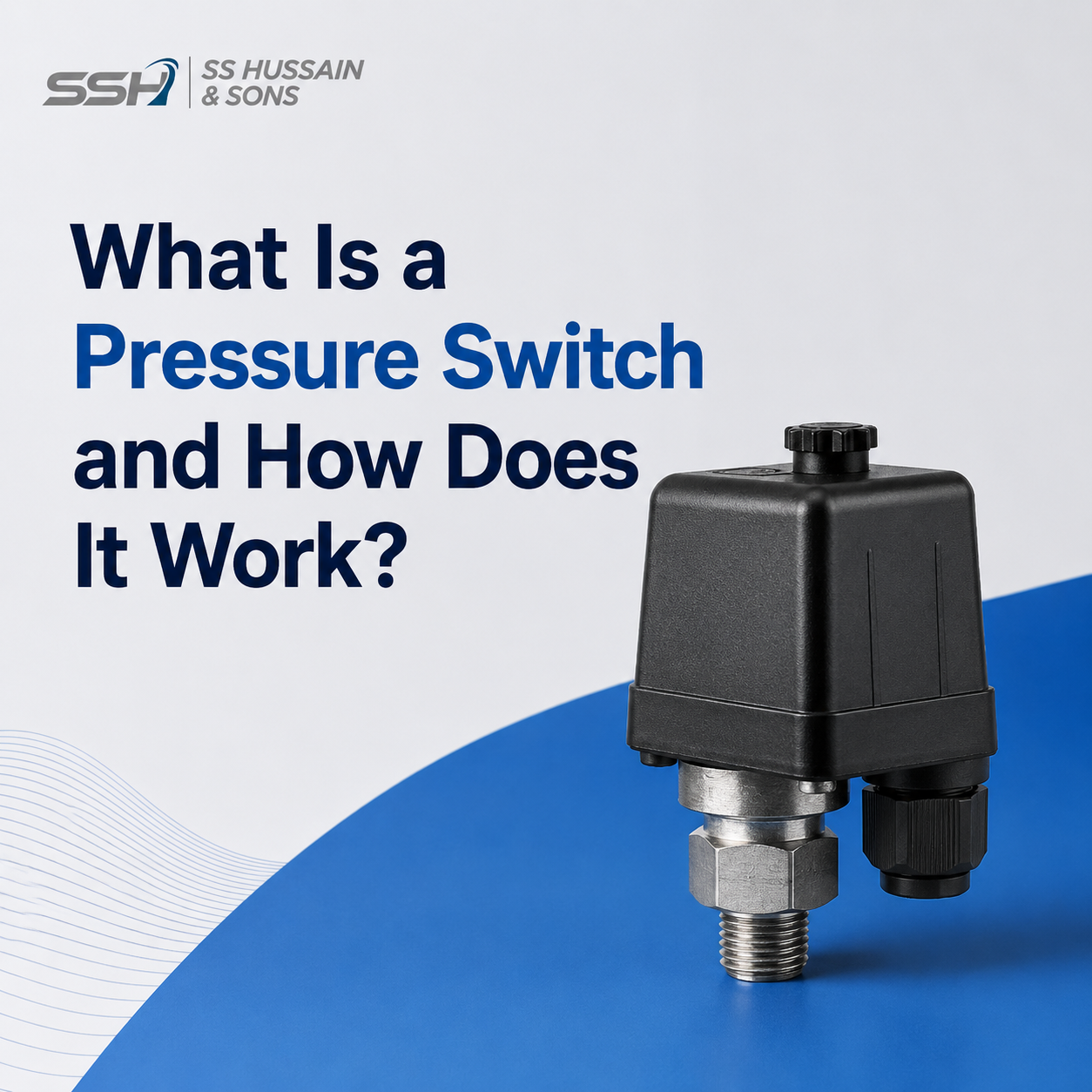
A pressure switch is an electrical device that monitors pressure and reacts once it reaches a set level.
It watches air, gas, or liquid pressure. When that pressure hits a preset point, the switch changes an electrical circuit. This can start a pump, stop a compressor, turn on an alarm, or send a signal to a control panel.
Think of it as a guard who watches pressure all day. Unlike a person, it never gets tired and never misses a change.
Industrial pressure switches show up in many places. You’ll find them in factories, water treatment plants, HVAC systems, food processing plants, pharmaceutical facilities, and oil and gas operations.
In short: a pressure switch is an automatic, always-on guard for pressure levels.
How Does a Pressure Switch Work?
A pressure switch works by using a moving part to flip an electrical contact once pressure reaches a set value.
Inside the switch is a sensing element. Depending on the model, this is a diaphragm, a piston, or a set of bellows. As pressure changes, this part moves.
That movement pushes against a spring. The spring is already set to a specific pressure value. Once pressure reaches that value, electrical contacts inside the switch flip position.
The connected equipment reacts right away. It might start, stop, or send a signal to another controller. This whole process takes less than one second. It repeats every time pressure changes.
Air Compressor Example
An air compressor is an easy example to picture.
- The compressor fills the air tank, so pressure rises.
- Once the tank hits the preset high pressure, the switch turns the motor off.
- As compressed air gets used, pressure drops.
- Once pressure hits the low setting, the switch turns the motor back on.
This cycle repeats on its own. The compressor only runs when it actually needs to.
Water Pump Example
The same idea applies to water pumps.
- Someone opens a tap.
- Water pressure in the pipeline drops.
- The pressure switch senses this drop and starts the pump.
- Once pressure returns to normal, the switch turns the pump off.
You likely won’t notice this happening. The whole cycle runs on its own.
In short: a moving sensor plus a spring is what makes a pressure switch react automatically.
What Parts Are Inside a Pressure Switch?
A pressure switch has five main parts: a sensing element, a spring, electrical contacts, an adjustment screw, and a housing.
| Part | What It Does |
| Sensing element | Detects pressure changes |
| Spring | Sets the pressure point where switching happens |
| Electrical contacts | Opens or closes the circuit |
| Adjustment screw | Lets you change the pressure setting |
| Housing | Protects the inside from dust, moisture, and vibration |
Each part has one clear job. Together, they let the switch react the same way, every single time.
In short: five simple parts work together to make a pressure switch reliable.
Why Are Pressure Switches Used?
Pressure switches protect equipment by keeping pressure inside a safe range automatically.
Machines are built to run within a certain pressure range. Too much pressure wears out pumps, valves, seals, and pipelines faster. Too little pressure can stop equipment from working right.
A pressure switch prevents both problems by reacting the instant pressure moves out of range.
Common uses include:
- Starting and stopping air compressors
- Controlling water pumps
- Protecting hydraulic equipment
- Monitoring refrigerant pressure in HVAC systems
- Sending signals to PLCs and automation panels
- Triggering alarms during abnormal pressure
- Protecting boilers and pressure vessels
Keeping pressure steady also cuts down on unneeded equipment cycling. Less cycling means lower maintenance costs over time.
In short: pressure switches protect equipment and cut maintenance costs by keeping pressure in range.
What Types of Pressure Switches Are There?
The four main types of pressure switches are mechanical, electronic, differential, and vacuum.
Not every job needs the same type. The right pick depends on your application.
Mechanical Pressure Switch
A mechanical pressure switch uses springs and electrical contacts to control equipment. It’s the most common type because it’s simple, reliable, and easy to maintain.
Electronic Pressure Switch
An electronic pressure switch uses an electronic pressure sensor instead of mechanical contacts. It usually offers higher accuracy, a digital display, programmable settings, and outputs for industrial automation systems.
Differential Pressure Switch
A differential pressure switch compares pressure between two points. You’ll often see these across air or water filters. As a filter gets dirty, the pressure gap grows. Once it hits a set value, the switch signals it’s time for maintenance.
Vacuum Pressure Switch
A vacuum pressure switch measures pressure below normal atmospheric pressure. These are common in vacuum pumps, packaging machines, lab equipment, and medical devices.
In short: pick mechanical for simplicity, electronic for accuracy, differential for filter monitoring, and vacuum for below-atmosphere pressure.
Pressure Switch vs Pressure Sensor: What’s the Difference?
A pressure sensor gives a constant reading, while a pressure switch acts only at one set point.
A pressure sensor measures pressure all the time. It sends that reading to a PLC, display, or controller as a stream of data.
A pressure switch waits. It does nothing until pressure hits a preset value, then it performs one action, like starting a motor.
Many industrial machines use both together. The sensor provides ongoing information. The switch handles the automatic control.
In short: a sensor reports pressure constantly, while a switch acts once at a set point.
How Do You Choose the Right Pressure Switch?
Choosing the right pressure switch means matching the pressure range, media type, and electrical rating to your equipment.
Start with your pressure range. The switch should comfortably handle your normal operating pressure, plus room for occasional spikes.
Next, check the pressure media. Some switches are built for air. Others are built for water, hydraulic oil, steam, chemicals, or gases.
Then match the electrical rating to your connected equipment. Make sure the process connection fits your existing piping. Pick a housing that suits your environment, especially if dust or moisture is present.
Getting these details right at the start usually means fewer problems later.
In short: match pressure range, media type, and electrical rating to avoid future issues.
How Does Installation Affect a Pressure Switch?
Poor installation, such as mounting a switch too close to a fast valve or pump, causes it to switch more often and wear out faster.
Sudden pressure spikes near a fast-closing valve or high-speed pump can make a switch react too often. Over time, this wears down the electrical contacts.
Installing the switch a short distance from heavy vibration helps. Adding a pressure snubber can also smooth out the pressure signal. Both steps help the switch last longer.
Leaving open space around the switch also makes future checks and repairs easier.
In short: good placement away from spikes and vibration extends a switch’s working life.
When Should You Replace a Pressure Switch?
Replace a pressure switch if it cycles too often, misses its set points, or shows leaks or burnt contacts.
Pressure switches rarely fail without warning. Watch for these signs:
- The pump or compressor starts and stops too often.
- Equipment doesn’t stop at the correct pressure.
- Equipment doesn’t restart after pressure drops.
- Pressure settings shift without anyone adjusting them.
- Leaks appear around the pressure connection.
- Electrical contacts look burnt or damaged.
Replacing a switch early helps you avoid sudden downtime and costly repairs later.
In short: watch for cycling issues, missed set points, and leaks as warning signs to replace a switch.
Where Are Pressure Switches Used?
Pressure switches are used across nearly every industry that relies on controlled pressure, from HVAC systems to food processing plants.
You’ll find pressure switches in:
- Air compressors
- Water pumps and booster pump systems
- Hydraulic and pneumatic equipment
- HVAC and refrigeration systems
- Boilers and chillers
- Fire protection systems
- Water treatment plants
- Food processing and pharmaceutical manufacturing
- Irrigation systems
- Industrial automation panels
- Reverse osmosis plants
- Pressure washers and commercial coffee machines
- Vehicle air conditioning systems
Many people use equipment with a pressure switch every single day without knowing it.
In short: pressure switches are built into dozens of everyday and industrial machines.
Conclusion
A pressure switch is a small part, but it plays a big role. It’s why pumps, compressors, and industrial equipment run smoothly day after day. Picking the right pressure switch from the start helps improve performance, cut maintenance, and prevent costly downtime.
If you’re choosing a pressure switch for a new project, or replacing an old one, good advice can save you time and money. SS Hussain offers a wide range of industrial pressure switches, pressure measurement devices, process instrumentation, and industrial automation solutions for many industries. Reach out to our team, and we’ll help you find the right product for your application.
FAQ
Can a pressure switch fail?
Yes. Dirt, moisture, vibration, worn contacts, pressure spikes, and normal wear can all affect how well a pressure switch performs over time.
Can you adjust a pressure switch?
Many mechanical pressure switches have an adjustment screw for changing the switching pressure. Always stay within the manufacturer’s recommended range.
How long does a pressure switch last?
Lifespan depends on switching frequency, operating pressure, installation quality, and maintenance. A well-installed switch can run for many years.
What happens if a pressure switch stops working?
Connected equipment may fail to start, fail to stop, or run outside its normal pressure range. This raises wear on pumps, compressors, and other parts.
What’s the difference between a pressure switch and a pressure sensor?
A pressure sensor gives a constant reading. A pressure switch waits and acts only once pressure hits one set point.
Which type of pressure switch is most common?
The mechanical pressure switch is most common. It’s simple, affordable, and easy to maintain compared to electronic models.