
-
Address: Shahrah-e-Liaquat,
Serai Quarters 74000, Karachi -
Call Us: +92 319 3961178
Email Us: info@sshussain.com
Quick Answer
A thermowell is a hollow metal tube that shields a temperature sensor from a process fluid. It sits inside a pipe or tank so the sensor never touches the liquid, gas, or steam directly. This protects the sensor, makes it easy to replace, and keeps temperature readings accurate for years.
What Is the Purpose of a Thermowell?
A temperature sensor can cost hundreds of dollars. One bad installation can ruin it fast. Direct exposure to heat, chemicals, or pressure wears sensors down quickly. That is why industries use a thermowell.
A thermowell protects the sensor. It still lets the sensor measure temperature accurately. It also makes maintenance faster and helps avoid unplanned shutdowns.
This guide answers the most common questions about thermowells in plain English.
What Is a Thermowell?
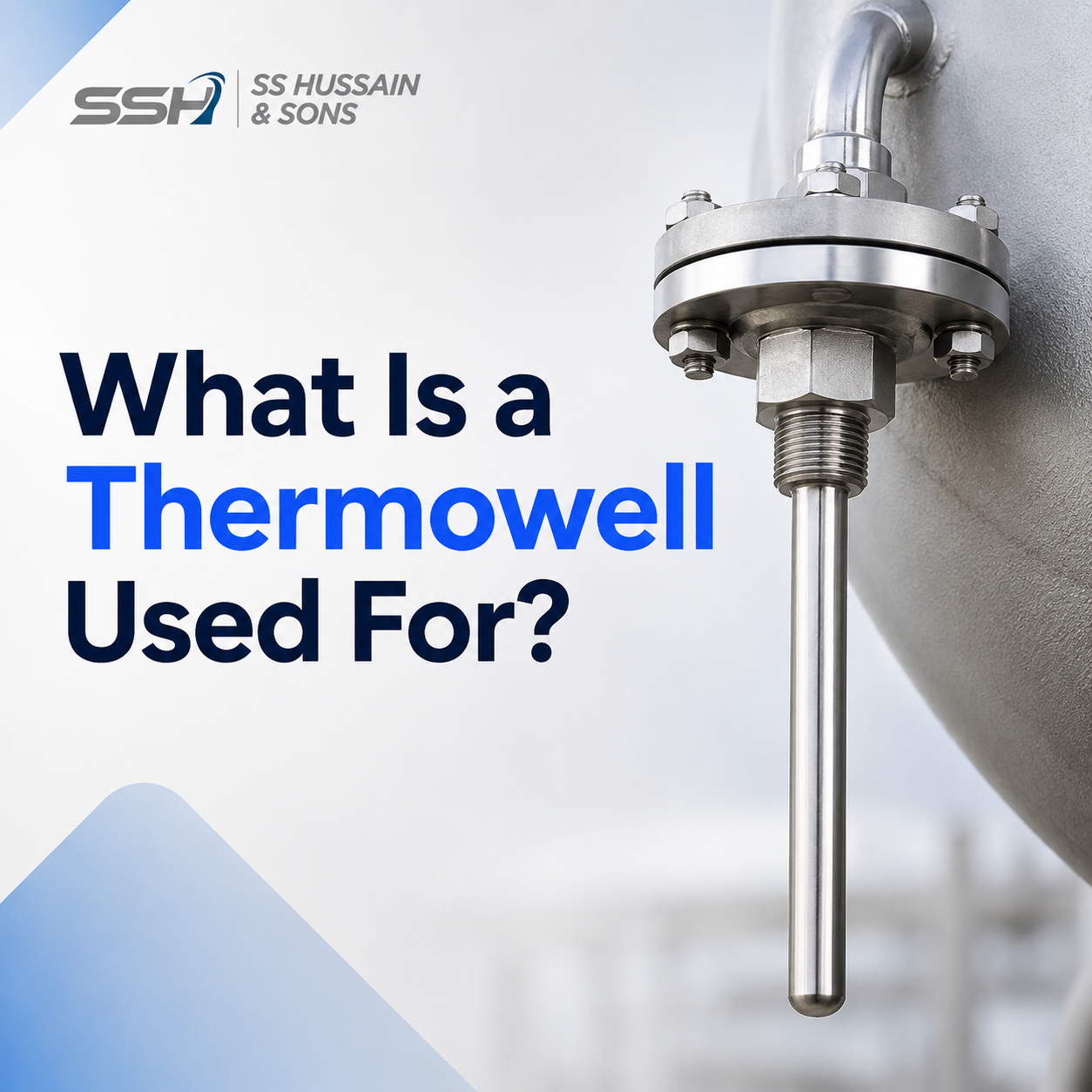
A thermowell is a hollow metal tube with one closed end that protects a temperature sensor from direct contact with a process fluid.
You install it into a pipe, tank, or vessel. A thermocouple or RTD sensor slides inside it. The sensor never touches the fluid. Instead, heat passes through the metal wall until it reaches the sensor.
This matters because industrial processes are tough on equipment. Hot steam, harsh chemicals, high pressure, and fast-moving liquids all wear down an exposed sensor. A thermowell acts as a barrier. It keeps the sensor safe while it still does its job.
In short: a thermowell shields your sensor without blocking an accurate reading.
How Does a Thermowell Work?
A thermowell works by absorbing the process temperature through its metal wall, then passing that heat to the sensor inside it.
Metal conducts heat quickly. As the fluid inside the pipe changes temperature, the thermowell changes too. The sensor reads the thermowell’s temperature, which stays very close to the real process temperature.
Four things affect how fast the sensor reacts:
- The thermowell material
- The wall thickness
- The insertion length
- How tightly the sensor fits inside
Here’s a detail most people miss. A loose sensor leaves small air gaps inside the thermowell. Air is a poor heat conductor, so the reading lags behind. Many plants fix this by adding thermal paste inside the thermowell. The paste fills the gaps and speeds up heat transfer.
In short: a snug fit and the right material help the sensor read temperature faster and more accurately.
Why Do Plants Use a Thermowell?
Plants use a thermowell to protect sensors from damage and to avoid shutting down the process every time a sensor needs replacing.
Without a thermowell, a sensor faces the full force of the process. Heat, chemicals, vibration, and pressure all shorten its life.
A thermowell helps by:
- Protecting RTDs and thermocouples from damage
- Making sensor replacement faster and safer
- Reducing maintenance time
- Improving worker safety
- Extending sensor life
- Keeping temperature readings stable
Replacing a damaged sensor without a thermowell can mean draining a line or shutting down part of the process. A thermowell lets you pull the sensor out without touching the process fluid at all.
In short: a thermowell saves money by cutting both sensor damage and downtime.
Where Are Thermowells Used?
Thermowells are used across oil and gas, chemical processing, food and beverage, power generation, pharmaceuticals, and water treatment.
Oil and Gas
Pipelines, storage tanks, refineries, compressors, and separators all rely on thermowells for safe, steady temperature monitoring.
Chemical Processing
Many chemicals corrode exposed sensors over time. Corrosion-resistant thermowells protect them and cut replacement costs.
Food and Beverage
Pasteurization, dairy production, and beverage manufacturing all need precise temperature control. Sanitary thermowells keep the process clean while protecting the sensor.
Power Generation
Boilers, turbines, steam lines, generators, and heat exchangers need reliable temperature readings to run efficiently.
Other Industries
You’ll also find thermowells in:
- Pharmaceutical manufacturing
- Water treatment plants
- HVAC systems
- Marine equipment
- Paper mills
- General manufacturing
In short: if a process involves heat, pressure, or chemicals, there’s a good chance it uses a thermowell.
What Materials Are Thermowells Made From?
Most thermowells are made from stainless steel, but tougher processes need alloys like Hastelloy, Monel, Inconel, or titanium.
Stainless steel is the most common choice. It resists corrosion and transfers heat well at a reasonable cost.
For harsher chemicals or extreme temperatures, plants often choose:
- Hastelloy
- Monel
- Inconel
- Titanium
The right material prevents corrosion and extends the thermowell’s working life.
In short: match the material to the chemical and temperature conditions of your process.
What Types of Thermowells Are Available?
Thermowells come in different connection types and shapes to match different pipe pressures and process conditions.
Connection Types
- Threaded thermowells work well for low and medium-pressure jobs.
- Flanged thermowells suit larger pipelines and higher-pressure services.
- Socket weld thermowells create a permanent welded connection.
- Weld-in thermowells are used where leaks cannot be tolerated.
Thermowell Shapes
- Straight thermowells fit most general-purpose applications.
- Tapered thermowells narrow near the tip, which cuts vibration while keeping strength.
- Stepped thermowells have a thinner sensing tip, so heat reaches the sensor faster.
In short: choose the shape and connection based on your process, not on which one looks strongest.
How Do You Choose the Right Thermowell?
Choosing the right thermowell means matching it to your process temperature, pressure, fluid type, and flow speed.
Ask these questions first:
- What temperature will the thermowell see?
- How much pressure is inside the pipe?
- What liquid or gas is flowing through it?
- How fast is that fluid moving?
The answers guide your choice of material, connection type, insertion length, and overall design.
Flow velocity deserves special attention. Fast-moving steam or liquid pushes against the thermowell nonstop. If the design doesn’t account for that force, vibration can wear it out early.
In short: the right thermowell fits your exact process conditions, not a generic standard.
Why Does Insertion Length Matter?
Insertion length matters because a thermowell must reach deep enough into the pipe to sense the true fluid temperature.
If only the tip enters the pipe, heat escapes through the pipe wall before it reaches the sensor. This gives a reading that’s lower than the real temperature.
The right insertion length places the sensing tip where the fluid actually flows. That gives you a far more accurate reading.
It sounds like a small detail. It can still cause a real gap between the reading and reality.
In short: an insertion length that’s too short leads to inaccurate temperature data.
Why Do Thermowells Fail?
Thermowells most often fail because of flow-induced vibration, not just heat or pressure.
As fluid moves around the thermowell, it creates small, constant vibrations. If those vibrations match the thermowell’s natural frequency, the metal weakens over time. This is called resonance, and it can lead to sudden failure.
That is why many industries follow the ASME PTC 19.3 TW standard. Engineers use it to calculate vibration risk before installing a thermowell.
In short: vibration, not heat, is usually the real reason a thermowell breaks down.
Common Installation Mistakes to Avoid
The most common thermowell installation mistakes involve wrong insertion length, wrong material, and ignoring vibration risk.
Watch out for these mistakes:
- Choosing the wrong insertion length
- Selecting the wrong material for the process
- Installing it in an area with very low fluid flow
- Skipping vibration calculations in high-flow applications
- Leaving large air gaps between the sensor and thermowell
Getting these details right the first time saves money, improves accuracy, and cuts future maintenance.
In short: most thermowell problems trace back to a mistake made during installation.
Conclusion
A thermowell looks like a simple metal tube, but it does an important job. It protects temperature sensors, RTDs, and thermocouples. It keeps readings accurate. It makes maintenance far easier. That’s why you’ll find thermowells across oil and gas, chemical plants, food processing, pharmaceuticals, and power generation.
Choosing the right thermowell now can prevent costly repairs, bad readings, and production delays later.
FAQ
Does a thermowell reduce temperature accuracy?
No. A properly selected thermowell gives very accurate readings. Response time is slightly slower than a bare sensor since heat must pass through the metal wall first.
Does every temperature sensor need a thermowell?
No. Small lab equipment or low-pressure water systems often skip it. A thermowell becomes essential for steam, chemicals, high pressure, or high-flow processes.
How long does a thermowell last?
It depends on material, process temperature, flow velocity, corrosion level, and maintenance. A well-chosen thermowell can last for many years.
What is the difference between a thermowell for a thermocouple and one for an RTD?
Both protect the sensor the same way. The main difference is the bore size and tip design, which must match the specific sensor’s dimensions.
Can a thermowell be repaired after vibration damage?
Usually not. Vibration fatigue weakens the metal internally. Most plants replace a damaged thermowell rather than repair it, then correct the design to prevent it from happening again.