
-
Address: Shahrah-e-Liaquat,
Serai Quarters 74000, Karachi -
Call Us: +92 319 3961178
Email Us: info@sshussain.com
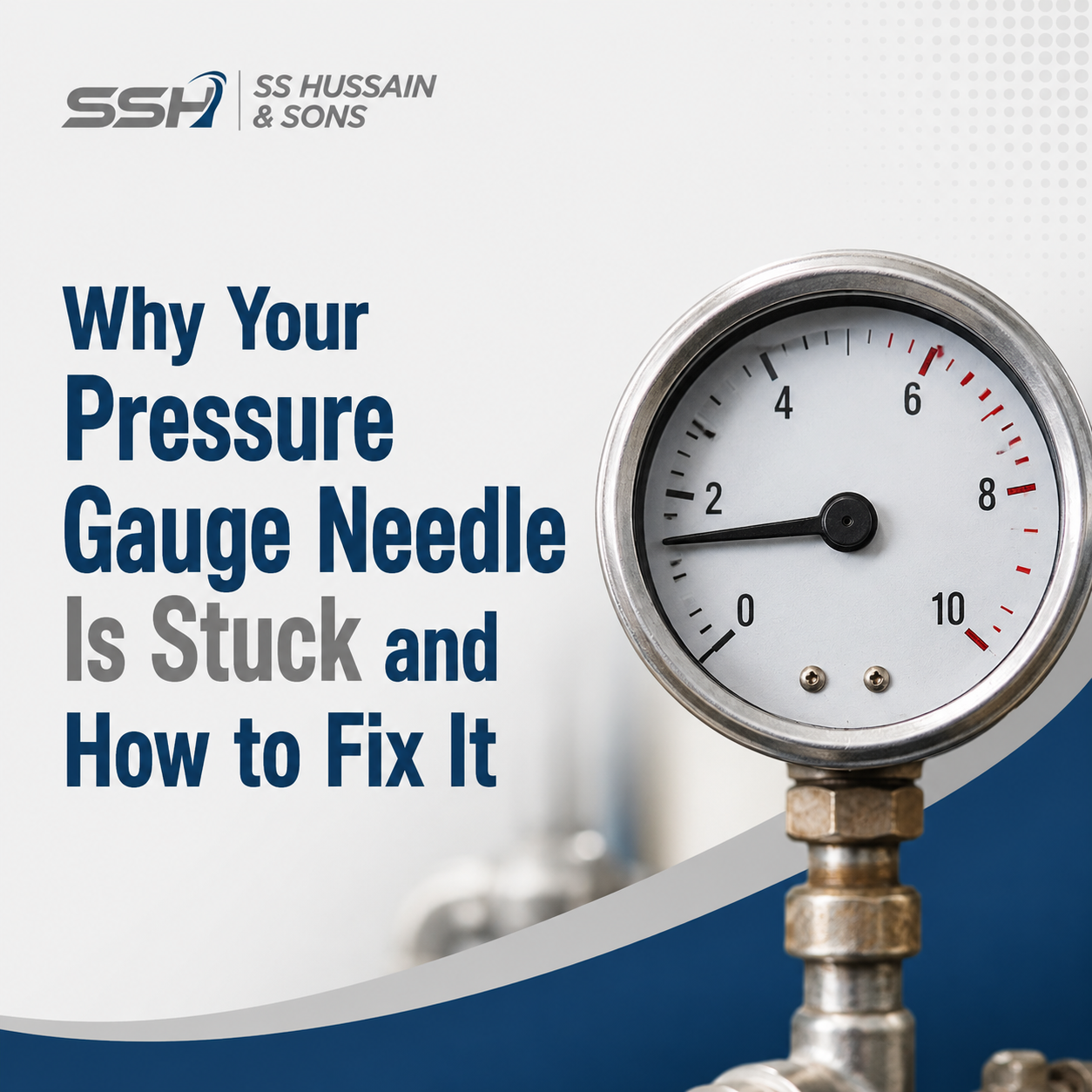
You check the pressure gauge for a quick reading, but the needle refuses to move. Now you’re left guessing if the pressure is actually steady or if the gauge has stopped doing its job. That small needle can tell you a lot, and when it gets stuck, it is usually trying to tell you something too.
A pressure gauge needle stuck in one position is a common issue in pumps, compressors, hydraulic equipment, boilers, and water pipelines. The good part is that the cause is often easy to find once you know where to look. Let’s go through it step by step.
How Does a Pressure Gauge Needle Work?
A pressure gauge measures the pressure of a liquid or gas inside a pipe or machine.
Inside a standard Bourdon tube pressure gauge is a curved metal tube. As pressure enters the gauge, the tube moves slightly. That movement turns a small set of gears, which moves the needle across the dial.
Everything inside the gauge is designed to move with very little force. Because of that, dirt, rust, vibration, moisture, or damage can stop the needle from moving as it should.
Why Is Your Pressure Gauge Needle Stuck?
A pressure gauge needle not moving usually comes down to one of a handful of problems. Some are easy to fix, while others mean the gauge has reached the end of its life.
Dirt or Debris Is Blocking the Pressure Port
The pressure port is the opening where pressure enters the gauge.
Over time, rust, welding particles, pipe scale, dried thread sealant, or thick liquids can block this small passage. When pressure cannot reach the Bourdon tube, the needle stays in the same position even though pressure inside the line is changing.
This happens quite often after new pipelines are installed. Tiny metal particles left inside the pipe can travel straight into the gauge during startup.
If the blockage is only in the threaded connection, cleaning it may solve the problem. If dirt has reached the inside of the gauge, replacing it is normally the better option because the internal parts are factory calibrated.
Pressure Spikes Can Damage the Gauge Without You Noticing
Many people look at the normal operating pressure and assume everything is fine. The gauge may tell a different story.
Picture an air compressor running at 100 psi. Every time a valve closes suddenly, the pressure may briefly jump much higher before settling back down. The jump happens so quickly that you never see it on the dial, yet the gauge still experiences it.
After hundreds or even thousands of these pressure spikes, the Bourdon tube slowly changes shape. The needle may stick, move slowly, or stop returning to zero.
A pressure snubber or pulsation dampener helps absorb these sudden pressure changes and can add years to the life of the gauge.
Constant Vibration Slowly Wears Out the Gauge
A pressure gauge mounted on a compressor or pump may vibrate every second the equipment is running.
At first, the shaking looks harmless. After months of continuous operation, the tiny gears inside the gauge begin to wear. The needle may wobble, move in small jumps, or stop moving altogether.
That is one reason liquid filled pressure gauges are so popular. The liquid helps steady the needle and protects the moving parts from constant vibration.
If your gauge shakes even when the pressure stays steady, switching to a liquid filled model is usually a smart move.
Moisture Can Cause Corrosion Inside the Gauge
People usually expect corrosion when water gets into the process line. In reality, moisture can build up inside the gauge another way.
A pressure gauge installed outdoors heats up during the day and cools down at night. That change in temperature creates condensation inside the case. Over time, tiny water droplets cause rust on the gears and springs.
Eventually, the needle becomes harder to move and starts sticking.
Choosing a stainless steel pressure gauge or a liquid filled pressure gauge helps reduce this problem in outdoor and humid environments.
The Gauge Has Simply Worn Out
Pressure gauges work every day, often for years. Every pressure change creates a small movement inside the gauge.
Those tiny movements slowly wear the gears, springs, and Bourdon tube. Eventually, the gauge loses accuracy.
Some common signs include:
- The pressure gauge needle stays above zero after pressure is released.
- The needle moves in sudden jumps.
- The reading changes every time the equipment starts.
- The needle sticks at one number.
When these signs appear together, replacing the gauge is usually the best solution.
How Can You Tell If the Pressure Gauge Is Faulty?
A faulty pressure gauge rarely fails without warning. It usually shows small signs before it stops working completely.
Check for these common problems:
- The pressure gauge needle is stuck at zero while the equipment is running.
- The needle does not return to zero after pressure is released.
- The needle moves slowly or jumps across the dial.
- Moisture or fog appears inside the lens.
- The case is cracked, dented, or badly corroded.
- The reading is different from another calibrated pressure gauge.
If you notice several of these signs together, there is a good chance the gauge needs attention.
How to Fix a Stuck Pressure Gauge Needle
Before removing a pressure gauge, always release the pressure from the line and follow the correct safety procedure.
Then work through these steps.
- Check the pressure connection for dirt or blockage.
- Inspect the gauge for cracks, dents, corrosion, or leaks.
- Compare the reading with another calibrated pressure gauge.
- Look for vibration or repeated pressure spikes in the equipment.
- Replace the gauge if the needle stays stuck or the readings remain inaccurate.
Trying to repair the internal mechanism is rarely worthwhile. Once factory calibration is disturbed, the readings may no longer be accurate.
Can You Repair a Pressure Gauge?
Cleaning a blocked pressure connection can sometimes bring a gauge back to life.
If the Bourdon tube or internal gears have been damaged, repairing the gauge is usually not practical. Even if the needle moves again, the readings may still be incorrect.
For industrial applications, replacing the gauge is normally the safer and more reliable option.
How Can You Prevent a Pressure Gauge Needle From Getting Stuck?
A few simple habits can help your pressure gauge last much longer.
- Choose the correct pressure range for the application.
- Keep the normal operating pressure around the middle of the dial.
- Install a pressure snubber if pressure spikes happen regularly.
- Use a liquid filled pressure gauge on vibrating equipment.
- Choose a stainless steel pressure gauge for wet or corrosive locations.
- Inspect gauges regularly for leaks, rust, cracked lenses, or needles that no longer return to zero.
- Compare important gauges with a calibrated test gauge during scheduled maintenance.
These small checks improve pressure gauge accuracy and help you spot problems before they become expensive repairs.
When Should You Replace a Pressure Gauge?
Replacing a pressure gauge is the right choice if cleaning does not solve the problem, the readings are inaccurate, or the gauge has visible damage.
It should also be replaced if the Bourdon tube has been damaged by overpressure, the needle stays stuck, or the gauge has simply reached the end of its service life.
Using a faulty pressure gauge can lead to incorrect pressure readings, damaged equipment, unnecessary downtime, and higher maintenance costs.
Conclusion
A pressure gauge needle stuck in one position is easy to ignore, yet it can point to a problem that keeps getting worse. Checking the gauge early can help you avoid damaged equipment, unexpected shutdowns, and expensive repairs later.
If your pressure gauge needs replacing or you’re unsure which model is right for your application, SS Hussain is ready to help. We supply high-quality industrial pressure gauges, liquid filled pressure gauges, stainless steel pressure gauges, pressure gauge accessories, and complete pressure measurement solutions for a wide range of industries. Get in touch with our team today and we’ll help you choose a pressure gauge that gives accurate readings from day one and keeps your operation running smoothly.
Frequently Asked Questions
Why is my pressure gauge needle stuck even when the pressure changes?
A pressure gauge needle can stay stuck if the pressure port is blocked, the internal parts are worn, or the Bourdon tube has been damaged by overpressure. Vibration, corrosion, and dirt inside the gauge can also stop the needle from moving freely.
Can a pressure gauge work even if the needle does not return to zero?
No. A pressure gauge that does not return to zero after pressure is released is no longer fully accurate. It may still move, but the readings can be incorrect and should be checked or replaced.
Is it safe to keep using a pressure gauge with a stuck needle?
It is not recommended. A stuck pressure gauge can display the wrong pressure, making it difficult to detect unsafe operating conditions. Replacing a faulty gauge is safer than relying on inaccurate readings.
How long does an industrial pressure gauge usually last?
The lifespan depends on the operating conditions. A quality industrial pressure gauge can last for several years, but vibration, pressure spikes, moisture, and harsh environments can shorten its service life.