
-
Address: Shahrah-e-Liaquat,
Serai Quarters 74000, Karachi -
Call Us: +92 319 3961178
Email Us: info@sshussain.com
Quick Answer
For most wastewater lines, an electromagnetic flow meter is the best choice when the pipe runs full and you can install the meter permanently. If cutting into the pipe is not an option or you need a portable reading, a clamp-on ultrasonic flow meter is a better alternative. In either case, it is best to avoid meters with moving parts, as solids and grease in wastewater can cause them to jam.
Why Is Wastewater Hard to Measure?
Wastewater is hard to measure because it carries solids, grease, air bubbles, and sometimes chemicals. Since wastewater is water that has already been used, a meter that works well on clean water can clog, drift, or fail in this liquid. That is why the right meter depends on what is in your pipe.
What Should You Ask Before Choosing a Flow Meter for Wastewater?
You should answer four questions first because they narrow your choice quickly.
- What type of wastewater is it? Raw sewage and sludge contain solids, while treated effluent (water that has been through treatment) is cleaner. Industrial effluent may contain chemicals.
- Is the pipe always full? Most meters read correctly only when the pipe is full.
- Can you shut down and cut the pipe? This decides between an inline meter and a clamp-on meter. An inline meter is installed as part of the pipe line.
- Do you need permanent monitoring or a one-time check?
Which Flow Meter Is Best for Wastewater?
In short: use an electromagnetic meter for permanent installation, or a clamp-on ultrasonic meter when you cannot cut the pipe.
What Is an Electromagnetic Flow Meter and When Should You Use It?
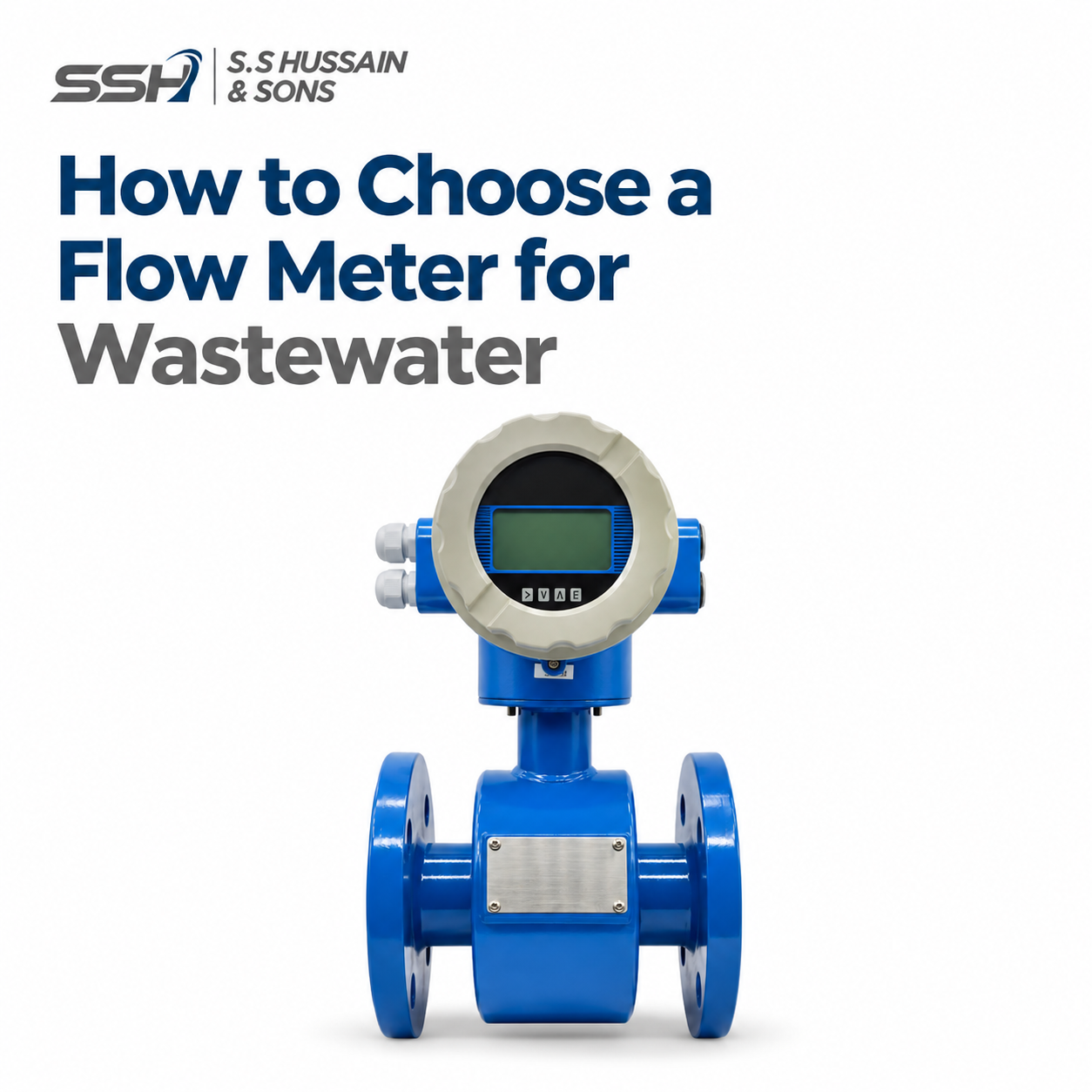
An electromagnetic flow meter, also called a mag meter, measures flow by passing liquid through a magnetic field and reading the voltage this creates. It has no moving parts and nothing blocking the pipe, so solids and slurry flow straight through. Slurry is a thick mix of liquid and solids.
This makes it a strong choice for sewage, sludge, and effluent. However, keep two things in mind:
- The liquid must conduct electricity. Wastewater normally does.
- The pipe must be full.
SS Hussain & Sons offers the WFD-DN50 Electromagnetic Flowmeter. It is designed for conductive liquids in 50 mm pipes.
When Should You Use a Clamp-On Ultrasonic Flow Meter?
A clamp-on ultrasonic flow meter attaches to the outside of the pipe and sends sound waves through it. Because it stays outside the pipe, you do not need to shut down the system, cut the pipe, or risk leaks.
SS Hussain & Sons has portable, handheld, and wall-mounted ultrasonic flow meters. The TUF-2000 portable meter has these specifications:
- Pipe size: 15 mm to 6000 mm
- Fluid temperature: up to 90 °C
- Accuracy: ±1% to ±2% of reading
However, heavy scale inside the pipe, thick liners, or many air bubbles can weaken the signal. Ask your supplier which model suits dirty liquid and which suits clean liquid.
Which Flow Meters Should You Avoid for Wastewater?
Avoid turbine and oval gear meters because they have spinning rotors or tight gears and are built for clean fluids. As a result, debris in wastewater can jam them.
How Do Electromagnetic and Ultrasonic Flow Meters Compare?
The main difference is how you install them. An electromagnetic meter goes inside the pipe line, while a clamp-on ultrasonic meter stays outside the pipe.
| Electromagnetic | Clamp-on ultrasonic | |
| Installation | Inline, pipe is cut | Outside the pipe, no cutting |
| Handles solids | Yes | Depends on the model |
| Pipe must be full | Yes | Yes |
| Best for | Permanent monitoring | Checks, audits, retrofits |
What Should You Check Before You Buy a Wastewater Flow Meter?
Check these details before you order:
- Pipe size and material
- Minimum and maximum flow rate
- Fluid temperature and pressure
- Enough straight pipe before and after the meter, as the manufacturer recommends
- The output you need, such as a local display or a signal to your control system
- Power supply at the site
FAQs
What is the best flow meter for sewage?
An electromagnetic flow meter is the best choice because it has no moving parts and nothing blocking the pipe, so solids pass through freely.
Can you measure wastewater flow without cutting the pipe?
Yes. A clamp-on ultrasonic flow meter attaches to the outside of the pipe, so you do not need to shut down the system.
Does the pipe need to be full?
Yes, for both meter types. A partly filled pipe gives inaccurate readings.
Why should you avoid turbine and oval gear meters for wastewater?
These meters have spinning rotors or tight gears and are built for clean fluids. Solids and debris in wastewater can jam them.
What pipe sizes can the TUF-2000 portable ultrasonic flow meter measure?
The TUF-2000 measures pipes from 15 mm to 6000 mm. It handles fluid up to 90 °C, with accuracy of ±1% to ±2% of reading.
Which Flow Meter Should You Choose for Wastewater?
Choose an electromagnetic flow meter if the pipe runs full and you can install the meter permanently. If you cannot cut the pipe, choose a clamp-on ultrasonic flow meter instead. In either case, avoid meters with moving parts and check your pipe size, flow range, and temperature before you buy
Need help choosing? Send us your pipe size, fluid type, and flow range. Our team will recommend the right meter. Call or WhatsApp +92 319 3961178, email info@sshussain.com, or request a quote.