
-
Address: Shahrah-e-Liaquat,
Serai Quarters 74000, Karachi -
Call Us: +92 319 3961178
Email Us: info@sshussain.com
Quick Answer
Faisalabad handles the full textile value chain in one city, from ginning and spinning to weaving, dyeing, and finishing. That means a new mill here needs all six instrument categories working together from day one: pressure, temperature, humidity, flow, level, and pneumatic air systems. Cotton dust is a bigger day to day concern in Faisalabad than in most other textile cities, since it affects sensor accuracy, seal life, and worker health. The hot, mostly dry inland climate also puts different demands on instruments than a coastal city would, with a short humid spell during the monsoon in July and August.
Pressure Instruments
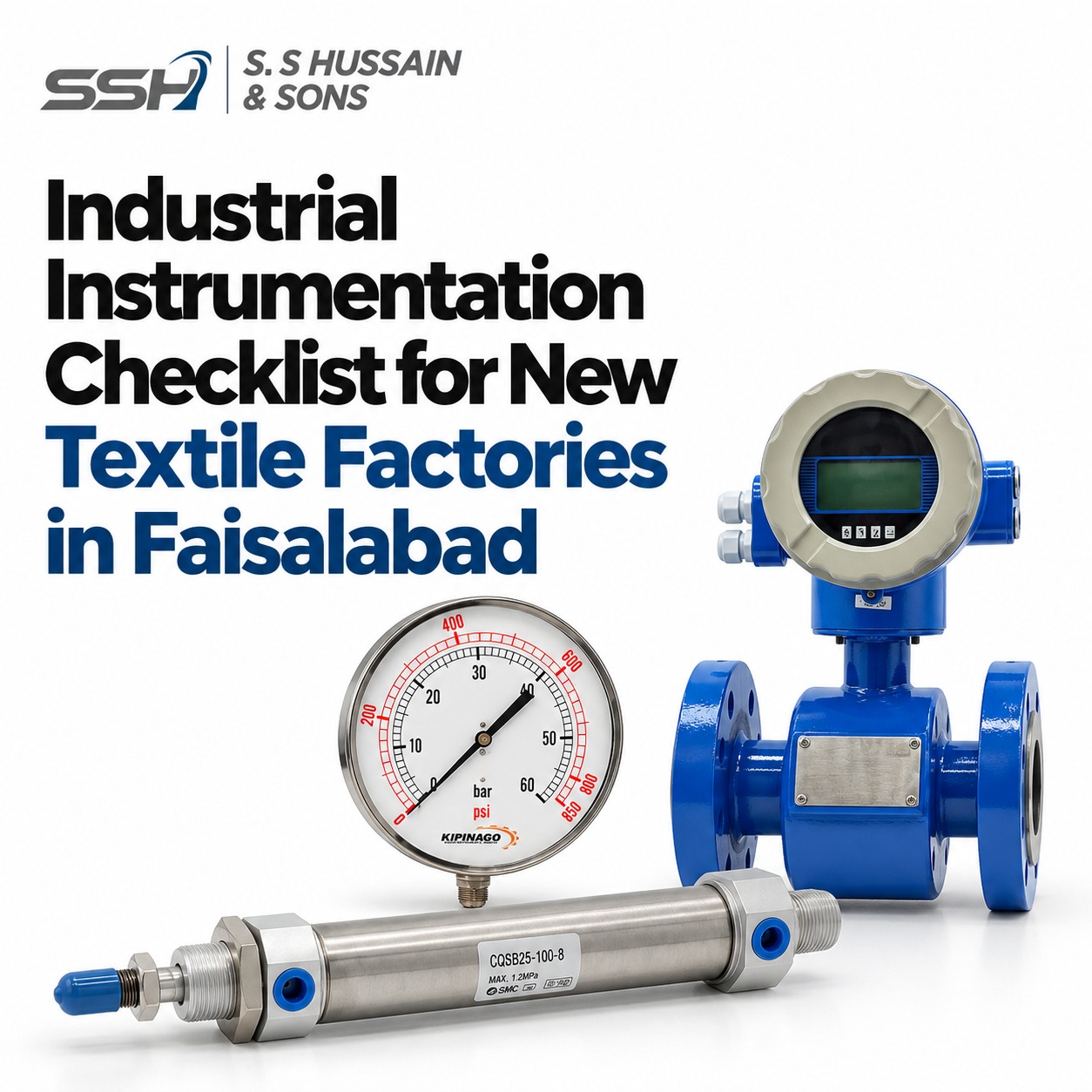
Pressure measurement is used across every stage of a Faisalabad mill, from compressed air systems and steam lines to boilers, dyeing machines, and HVAC systems. Since ginning, spinning, and weaving often run on the same site, pressure monitoring needs to cover a wider range of process areas than a garment only unit would.
Main instruments include:
- Pressure gauges for direct pressure readings. Bourdon tube gauges work for general mechanical measurement, while digital gauges give more precision.
- Pressure transmitters that send data to PLCs and automation systems.
- Pressure switches to trigger alarms or shutdowns at a set pressure, especially important around compressors and boilers.
- Diaphragm seals to protect gauges from steam, dye chemicals, and other harsh process conditions.
Gauge connection type matters too. Back and bottom connections are common choices. Brass works fine for general use, but stainless steel holds up better against chemical exposure in dyeing and finishing sections.
Temperature Instruments
Temperature control has a direct impact on quality, especially in dyeing and finishing, where a small error can ruin a whole batch. Faisalabad summers push average highs to around 45°C in June, so ambient heat needs to be accounted for or process readings can run higher than expected.
Common instruments are dial thermometers for general monitoring, switch-contact thermometers to trigger alarms when readings move out of range, and digital thermometers for accurate spot checks. Temperature and humidity should always be measured together, since even small temperature shifts change relative humidity readings.
Humidity Control
Humidity is critical in spinning and weaving, and this is where Faisalabad’s climate works against the mill. Hot, dry conditions dominate most of the year, especially May and June, which is the opposite of what spinning rooms need. Wrong humidity damages fiber strength, causes yarn breaks, and leads to static buildup, so most spinning rooms need active humidification, not just monitoring.
Many mills target around 65% relative humidity at 20-24°C, though the ideal range depends on the fiber and machinery. Hygrometers are common across production floors and warehouses, with larger mills using several monitoring stations. A hygrometer should always sit alongside an accurate temperature sensor, since seasonal swings between summer and winter can throw off the humidity reading otherwise.
Flow Meters
Flow meters manage water, steam, chemicals, and fuel across the mill. This matters more in Faisalabad than in a finishing only city, since the full process chain, from ginning through dyeing and washing, depends on accurate flow data at multiple stages.
The meter should suit the application:
- Ultrasonic flow meters for pure water, with no contact with the fluid.
- Vortex flow meters for steam measurement.
- Oval gear flow meters for dosing chemicals.
- Diesel flow meters for tracking generator and boiler fuel use. This is especially relevant in Faisalabad, where gas supply to industrial areas has a long history of shortages and mills often depend on backup diesel generators to keep running.
Level Instruments
Level measurement prevents tank overflow, dry running, and process interruptions in dye vats, chemical storage tanks, effluent treatment tanks, and boiler feedwater systems.
Common options include guided wave or high frequency radar meters for chemical tanks, ultrasonic level meters for non contact water measurement, and tuning fork level switches for high and low level warnings.
Pneumatic Equipment
Looms, cutters, and pick-and-place systems all run on compressed air. A full pneumatic system typically includes an FRL air preparation unit, cylinders, directional control valves, solenoid manifolds, a compressor, fittings, and tubing.
Cotton dust is the main threat to this equipment here. Fine fiber dust from ginning, carding, and spinning settles on rods and works into seals, so filtration and regular cleaning matter more in Faisalabad than in cities without raw fiber processing on site.
Size the compressor to the mill’s total connected air demand in CFM, not one machine’s requirement. Check for leaks regularly too. Compressed air leaks waste energy, and with dust already straining seals, leaks tend to show up faster here.
Calibration
Calibration checks an instrument against a known standard and corrects for drift. Pressure gauges, thermometers, hygrometers, and flow meters should all be on a calibration schedule. Critical safety instruments like boiler and pressure vessel gauges are usually calibrated more often, often quarterly, while general instruments are typically checked annually.
FAQs
What humidity level is best for a textile spinning room in Faisalabad?
Most spinning rooms target around 65% relative humidity at 20 to 24°C. Because Faisalabad’s summer climate is naturally dry, mills usually need active humidification equipment to reach and hold that range, not just monitoring alone.
How does cotton dust affect instrumentation in Faisalabad mills?
Fine fiber dust from ginning, carding, and spinning settles on pneumatic rods and can interfere with sensor accuracy. Filtration, dust rated seals, and a regular cleaning schedule matter more here than in cities without raw fiber processing on site.
How often should textile factory instruments be calibrated?
Critical safety instruments, like boiler gauges, are often calibrated quarterly. General monitoring instruments are typically calibrated annually.
Why do textile factories need diaphragm seals on pressure gauges?
Diaphragm seals stop steam or dye chemicals from touching the gauge directly. Without one, the gauge wears out much faster.
What size air compressor does a Faisalabad textile factory need?
Size it to your total connected pneumatic load in CFM, not a single machine. Undersizing is one of the most common setup mistakes, and it tends to show up faster in dust heavy environments.
Conclusion
A textile factory in Faisalabad needs six instrument types working together: pressure, temperature, humidity, flow, level, and a full pneumatic system. Skipping any one raises the risk of downtime, rejected fabric, or failed safety audits, and cotton dust makes consistent maintenance even more important here than in cities handling only later processing stages. Match each instrument to its process area, size your compressed air system to your full factory load, and set a calibration schedule from day one.
How SS Hussain & Sons Can Help
We supply pressure gauges, temperature and humidity instruments, flow meters, level meters, and pneumatic equipment for textile mills across Faisalabad. Our brands include WIKA, Ashcroft, KIPINAGO, Festo, SMC, and HTC.
Our team can help you match the right gauge, sensor, or FRL setup to your exact process line, from ginning and spinning through to dyeing and finishing. We also offer calibration and consultancy services to keep your instruments audit ready. Get a Quote