
-
Address: Shahrah-e-Liaquat,
Serai Quarters 74000, Karachi -
Call Us: +92 319 3961178
Email Us: info@sshussain.com
Quick Answer
Pressure gauges clog on wastewater because solids, grease, and sticky sludge block the small port that leads to the gauge. A diaphragm seal fixes that. It puts a thin metal membrane between the wastewater and the gauge, so the wastewater never gets inside.
Why do pressure gauges clog on wastewater lines?
Solids, grease, and sludge settle inside the gauge port and harden there. Once the port is blocked, pressure can’t reach the gauge.
Three things cause most clogs:
- Solids and sludge settle in the small port and socket
- Grease and sticky media harden inside the port.
- Corrosive chemicals and abrasive grit wear down the gauge parts (this one is slower, but it adds up)
The gauge ends up showing a wrong reading, or zero. You might not catch it until something goes wrong in the process.
How do you know if your pressure gauge is clogged?
A pressure gauge reading zero while the system is running is the classic sign. No pressure is getting to the gauge element, so there’s nothing for it to show. And the other signs:
- Reading stuck at zero while the pump runs
- The needle sticks or moves slowly.
- It doesn’t match a second gauge or a transmitter
- It works again after you pull it off and clean it.
If you see any of this, then check the gauge port first.
How does a diaphragm seal stop clogging?
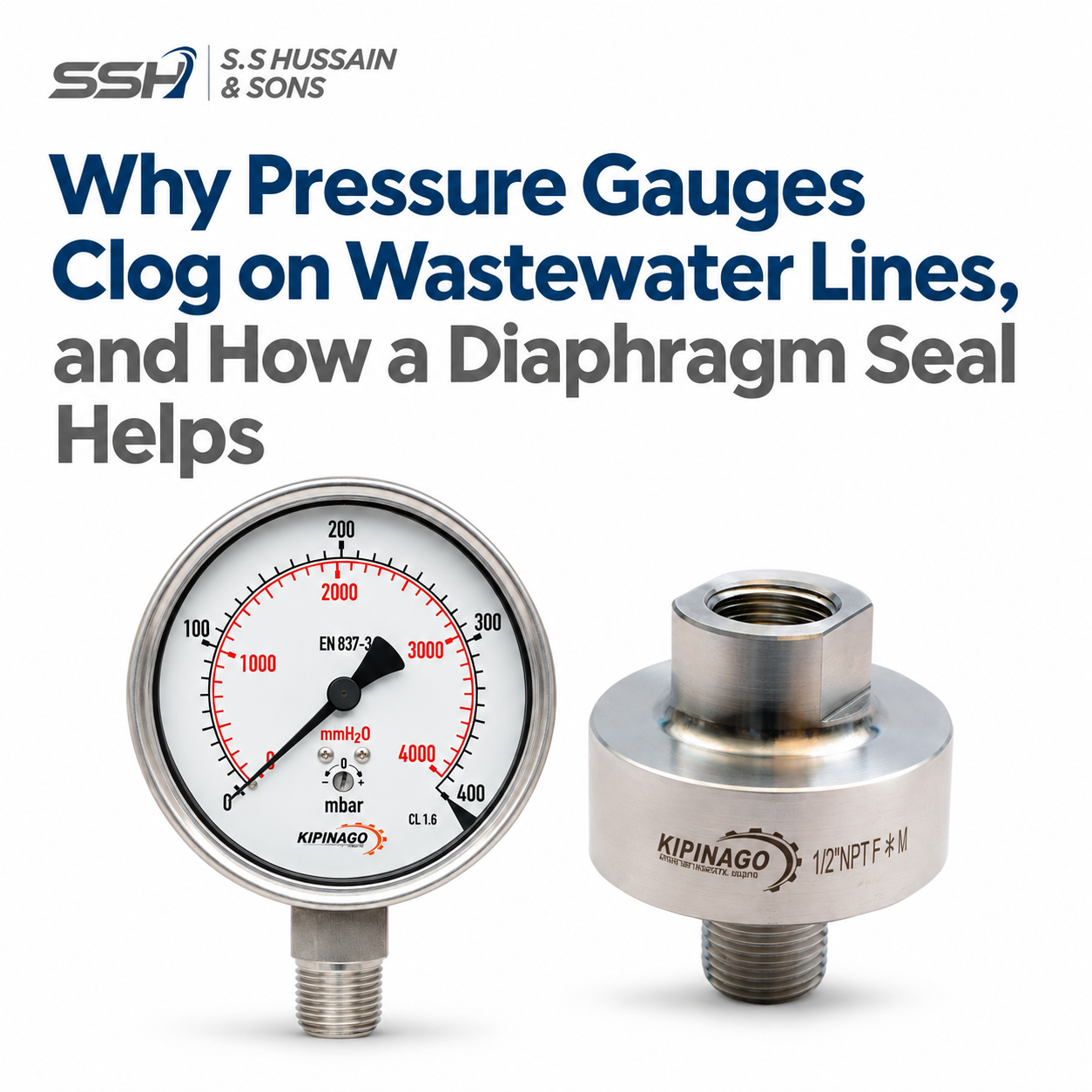
It keeps wastewater out of the gauge. A diaphragm seal (some people call it a chemical seal) is a thin, flexible metal membrane that sits between the process fluid and the instrument. Behind the membrane is a fill fluid, and that fluid carries the pressure to the gauge, so the wastewater itself never goes in.
You get three things out of this:
- The wastewater stays out of the gauge.
- A wide, flush diaphragm has no narrow port to block
- The gauge is protected from corrosion and heat.
A diaphragm seal is recommended for media with particles, since it gives a bigger flow area. Seals also work with pressure transmitters and pressure switches, not only gauges.
You can look through SS Hussain diaphragm seals, pressure gauges, and pressure transmitters.
How do you choose a diaphragm seal for wastewater?
Check five things: material, flushing ring, diaphragm size, mounting position, and fill fluid.
- Material. 316 stainless steel is fine for raw sewage and non-corrosive sludge. It fails fast in sodium hypochlorite, ferric chloride, and hydrochloric acid. A PTFE coating helps stop buildup from sticky sludge. Abrasive grit needs a harder alloy or a coated diaphragm.
- Flushing ring: sludge lines need one. You can clean the seal without taking it off the line.
- Diaphragm size. Wider is better because the flow area is bigger.
- Mounting position: a gauge mounted above the seal reads lower than the true pressure, and one mounted below reads higher. Calibration fixes this.
- Fill fluid. Pick one that suits your process temperature range.
How do you keep a diaphragm seal working?
Flush it on a regular schedule, and protect it from pressure spikes. Water hammer is common in wastewater force mains, and standard diaphragms don’t handle overpressure well.
A few ways to look after the seal and keep your readings right:
- Flush it through the flushing ring.
- Fit a snubber to cut down pressure pulsation
- Add filtration upstream, or heat tracing if the media solidifies at low temperatures.
- Book regular calibration to check accuracy
Conclusion
Standard gauges clog on wastewater lines because solids, grease, and sludge block the narrow gauge port. A diaphragm seal keeps all of that out of the gauge, so your readings stay accurate. Choose the material for your chemicals, add a flushing ring, and flush it on a schedule.
If you need help picking a seal and gauge, contact SS Hussain & Sons or ask about consultancy.
FAQs
Why does my pressure gauge show zero on a sludge line?
Most often it’s a clogged port. Solids block it, so pressure can’t get to the gauge. Remove and clean the gauge, then fit a diaphragm seal so it doesn’t happen again.
Does a diaphragm seal reduce gauge accuracy?
Not if the seal is placed and filled correctly. Mounting height can shift the reading, but calibration corrects it.
Can I add a diaphragm seal to an existing gauge?
The gauge and seal are usually filled and assembled together as one unit. Contact SS Hussain to match a seal to your gauge.